

 Shun Nagai
In recent years, as awareness of pet health continues to grow, more attention has also been paid to the quality of dog food. To protect dogs’ health, it is important to use high-quality ingredients with a well-balanced nutritional profile.
One ingredient that has been attracting attention is cassava, also known as tapioca. In this article, we explain how cassava can be useful in dog food manufacturing, along with its characteristics and advantages.
What Is Cassava?
Cassava is a perennial plant (a deciduous shrub) in the Euphorbiaceae family, native to South America. Its root has long been consumed by people living in tropical regions as a source of carbohydrates and minerals.
During the colonial era of Spain and Portugal, cassava spread from South America to Africa and Asia. Because it is highly drought-tolerant and can be cultivated even in dry soil, cassava remains an important source of carbohydrates and minerals for people living in tropical and subtropical regions.
Cassava is consumed by around 500 million people worldwide as a source of food and energy. In terms of scale as a carbohydrate crop, it is often said to rank after rice, corn, and wheat.
In addition, cassava is gaining attention as a sustainable ingredient. It is being considered as a raw material for ethanol production (biomass ethanol), and cassava leaves are also used as animal feed.
Nutritional Composition of Cassava
| Component | Value | Unit |
|---|---|---|
| Energy | 354 | kcal |
| Water | 14.2 | g |
| Protein | 0.1 | g |
| Fat | 0.2 | g |
| Carbohydrate | 85.3 | g |
| Sodium | 1 | mg |
| Potassium | 48 | mg |
| Calcium | 28 | mg |
| Magnesium | 5 | mg |
| Phosphorus | 6 | mg |
| Iron | 0.3 | mg |
| Copper | 0.03 | mg |
| Manganese | 0.09 | mg |
Values per 100 g edible portion
The Difference Between Cassava and Tapioca
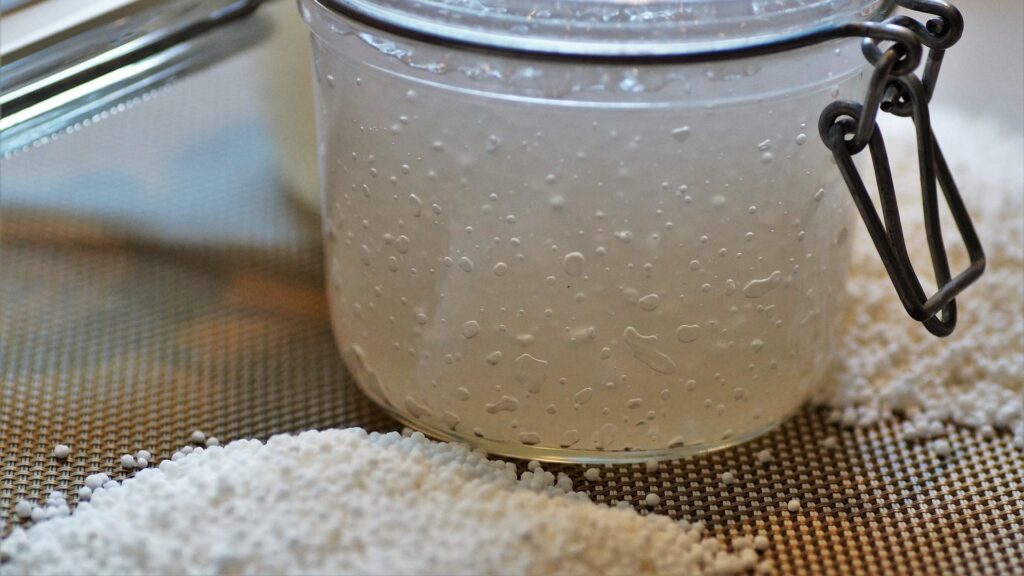
Tapioca refers to the starch extracted from the cassava root. During production, only the starch is removed from the root and processed into a powder. As a result, tapioca flour is made up almost entirely of starch and contains little of the nutritional value found in whole cassava other than energy.
However, because tapioca is rich in starch, it is known for its chewy and elastic texture. It is also gluten-free, which makes it suitable for products intended for dogs with gluten allergies.
Health Benefits of Cassava in Dog Food
Below are some of the health-related benefits of cassava in dog food.
Rich Source of Energy
Carbohydrates play an important role in supplying dogs with energy and are essential for exercise and a healthy lifestyle. Carbohydrates consumed through food are broken down into glucose, which is used as an energy source throughout the body.
Excess glucose is converted into glycogen and stored temporarily in the liver and muscles, where it can be used when energy is needed.
Supports Digestive Health
Cassava contains a small amount of resistant starch. This type of starch functions similarly to dietary fiber and may help support digestive health.
Three Advantages in Manufacturing
Gluten-Free
Proteins in food are among the most common causes of allergic reactions. For dogs with gluten allergies, cassava is often used as an alternative to ingredients such as wheat flour and barley, which contain gluten.
For this reason, cassava is recognized as a useful ingredient when developing limited-ingredient or gluten-free formulas.
Improves Kibble Texture
Cassava is not only highly digestible, but it is also valued in kibble and wet food for its contribution to palatability. This is because the shape, texture, and density of kibble, which affect palatability, depend heavily on the carbohydrate (starch) content of the formula.
In wet food as well, tapioca starch is often used to provide a specific texture.
Greater Formula Flexibility
Because cassava and tapioca contribute mainly starch to a recipe, they are convenient when adjusting a formula to meet specific nutritional targets or when designing lower-protein recipes for senior dogs.
Safety of Cassava
Cassava naturally contains cyanogenic glycosides, so if it is not properly processed, it may cause cyanide poisoning. Even small amounts consumed regularly can potentially have negative health effects.
However, the cassava flour used in dog food is sufficiently processed to remove these toxic compounds, so there is generally no need to worry about this issue.
May Contribute to Weight Gain
One point to keep in mind is that cassava is rich in carbohydrates, so feeding large amounts of cassava itself on a daily basis may lead to weight gain. However, when included in appropriate proportions in dog food, this is generally not a major concern.
OEM Manufacturing Using Cassava
Our company provides proposals for the development and contract manufacturing (OEM) of cat food and dog food in Thailand. So why Thailand? Below, we explain the reasons.
Dry dog food containing cassava can be manufactured.
Proven Track Record as a Major Pet Food Exporter
According to the Thai Pet Food Trade Association (TPFA), Thailand’s pet food exports exceeded 65 billion baht in 2021, up 27% year on year, making the country the world’s third-largest pet food exporter.
The top five export destinations for Thai pet food are the United States, Japan, Italy, Malaysia, and Australia. Demand for Thai pet food has also been increasing in Asian countries such as India, Indonesia, and Laos.
Thailand’s steady growth in pet food exports continued in 2022, with exports already up 43% year on year as of July, indicating even further acceleration.
According to Dr. Chanintr Chalisarapong, chairman of the TPFA, Thailand’s long experience in canned tuna production for human consumption—roughly one-fifth of the world’s canned tuna is produced in Thailand—has also contributed to the expansion of wet pet food manufacturing. As a result, wet food production in Thailand has become increasingly active.
Easy Access to High-Quality Raw Materials
Approximately 95% of the ingredients used in Thai pet food production, including fresh high-quality meat, grains, and seafood, are sourced locally. This has further supported the country’s manufacturing strength and success in global trade.
Thailand has a diverse climate and varied land conditions, allowing it to produce a wide range of agricultural products, including grains, vegetables, and fruits.
In addition, livestock farming is well established in Thailand, making it possible to source fresh, high-quality meat suitable for human consumption. Because Thailand is also surrounded by the sea, abundant seafood resources suitable for human consumption are available for use in pet food as well.
Cost Advantages
Thailand is known for its relatively low production costs. Compared with Japan and Western countries, labor costs are lower, and raw materials are easier to source.
This is a very attractive point for companies planning to develop new pet food products. Lower manufacturing costs help keep product prices competitive and support stronger positioning in the market.
Frequently Asked Questions
- QCan you manufacture products according to our desired formula?
- QWhat about the quality of raw materials used in OEM manufacturing in Thailand?
- QWhat kind of production equipment do Thai OEM manufacturers use?
- QWhat is the quality control system like in Thailand?
- QHow long does it take from inquiry to completion of the final product?
- QHow long does it take from placing an order to delivery?
Inquiries and Consultations

Please feel free to contact us with any questions or consultations regarding our OEM support services.
How to Contact Us
Phone: +66 (0)61-457-4310
You can call our representative directly. Phone support is the fastest way to receive quick answers and the information you need.
Email:
You can send an inquiry email to our representative’s email address. We will respond with detailed answers to your questions and requests.
What We Would Like You to Prepare
After receiving your inquiry, we will discuss the details based on your interests and needs. At that time, we will ask about the following points:
- Project Overview
Please tell us about the product you would like to develop and the purpose of the project. - Requests and Preferences
If you can share any specific product requirements, preferences, and budget, we will be able to make a more concrete proposal. - Schedule
Please let us know your target completion date and overall schedule for the product.
We value close communication with our clients and will do our utmost to support the success of your project.