

 Shun Nagai
In the pet food market, as consumers become increasingly particular about nutritional value and ingredient quality, the question of how to protect product quality all the way to consumption has become more important than ever. One often-overlooked factor in this equation is oxidation control through packaging.
Even pet food made with high-quality ingredients and carefully formulated recipes can suffer serious losses in flavor, palatability, and nutritional value if oxidation progresses during transportation or storage. This deterioration often happens quietly, before the product ever reaches the consumer’s eyes, and can ultimately damage the brand through complaints such as “my pet won’t eat it,” “it smells bad,” or “I can’t trust this product.”
In this article, we clearly explain how oxidation occurs in pet food, where the risks are most likely to arise, and how far packaging design can go in preventing it, with practical examples and countermeasures.
Why Oxidation Control Matters
The Risk of Quality Deterioration and Brand Damage
Premium dog food and cat food often emphasize unsaturated fatty acids such as omega-3s as key product benefits. However, these lipids readily react with oxygen in the air and are converted into lipid peroxides. As oxidation progresses further into secondary oxidation products such as aldehydes, pungent off-odors begin to appear.
From a nutritional standpoint, vitamins are depleted and essential fatty acids break down, putting both taste and functionality, which support the product’s value, at risk at the same time.
In addition, oxidative deterioration does not end with an increase in complaints or return costs. Reviews such as “it smelled bad when I opened it” can spread instantly on social media, and the higher the price point of the brand, the greater the expectation gap, which sharply increases the risk of brand damage. In other words, oxidation control is not only about protecting the product itself, but also about safeguarding corporate reputation and profitability through risk management.
“Silent Deterioration” That Progresses Before Anyone Notices
Lipid oxidation progresses gradually through a combination of factors such as temperature, water activity, light, and metal ions. In the early stages, changes in color and odor are extremely slight. By the time pet owners notice something unusual, the peroxide value (POV) may already have risen sharply, leading to visible problems such as pets refusing to eat the food or stronger stool odor.
This time lag—where the damage is already advanced by the time anyone notices—delays market feedback and makes it more likely that the issue will result in full-lot recalls or inventory disposal. Furthermore, as e-commerce continues to grow, temperature fluctuations in warehouses and delivery routes can no longer be ignored as factors that accelerate oxidation.
The Quality Management Capability Manufacturers Are Expected to Have
As technical differentiation through recipe development and ingredient selection alone becomes more difficult, optimizing packaging specifications is becoming the decisive factor in protecting quality to the very end. In business models that assume overseas shipping and long-term storage, the following three points are especially important when selecting an OEM partner:
- The ability to select high-barrier films:
Can they provide OTR/WVTR data and propose the right structure based on the product characteristics and target shelf life? - The ability to control oxygen concentration inside the package:
Can they reduce residual oxygen levels inside the bag and minimize pinholes? - The ability to design integrated temperature and humidity control across logistics:
Can they design not only the packaging itself, but also external factors such as warehouse air-conditioning standards?
In recent years, major pet food brands have begun adding oxidation stability data to their OEM selection criteria. The market now expects OEM manufacturers to optimize the product, packaging, and distribution as one complete system. Companies that can meet this expectation are the ones that will win long-term partnerships and meaningful differentiation.
Causes of Oxidation and How It Progresses
The Relationship Between Lipids in Raw Materials and Oxygen
Unsaturated Fatty Acids Oxidize Easily
Among the lipids contained in pet food, unsaturated fatty acids such as DHA, EPA, and linoleic acid are especially prone to oxidation. While they help support health maintenance, skin, and coat condition, their molecular structure contains double bonds, which makes them highly reactive with oxygen in the air and likely to trigger the initial stage of oxidation.
Trace Metal Ions Accelerate Oxidation
It may be surprising, but metal ions such as iron and copper also promote oxidation. When these minerals react with oxygen, they trigger radical chain reactions that accelerate lipid oxidation.
Foods containing raw materials rich in minerals, such as fish meal or blood meal, therefore require especially careful oxidation control through appropriate storage and packaging.
Higher Moisture Content Also Promotes Oxidation
Oxidation is often thought to slow down if the product is dry, but in reality, oxidation can still progress when water activity (aw) is 0.7 or higher. This means that semi-moist or soft-type pet foods are at higher risk of oxidation than fully dry products and require more delicate control.
In other words, oxidation risk begins at the formulation stage itself, depending on lipid type, mineral content, and moisture level. No matter how nutritionally advanced a recipe may be, without a proper oxidation control design to protect it, product quality may decline significantly before it ever reaches the pet’s bowl.
Where Does the Oxidation Risk Occur Before and After Opening?
| Phase | Main Trigger | High-Risk Operations / Conditions | Example Countermeasures |
|---|---|---|---|
| 1. Raw material storage | Oxygen, light, high temperature | Rising silo temperatures, exposed raw materials | Indoor storage (avoid rain, wind, and direct sunlight; ensure ventilation) |
| 2. Mixing / extrusion | High temperature, air entrainment | High-RPM mixers, delayed cooling after extrusion | Vacuum mixers, rapid cooling |
| 3. Filling / packaging | Residual oxygen inside the bag | Insufficient nitrogen flushing, pinholes | Residual O₂ ≤ 1%, oxygen absorber insertion |
| 4. Warehouse storage | Temperature fluctuations, UV exposure | Outdoor container storage | Control below 25°C, use light-shielding covers |
| 5. Transportation | Prolonged high temperatures | Near ship hulls, summer trucking | Insulated liners, temperature loggers |
| 6. Retail display | Light, temperature | Direct sunlight through glass cases | UV-cut bags, corrugated outer cartons |
| 7. After opening | Repeated air exposure | Long-term use of large-capacity bags | Smaller pack sizes + resealable zipper |
Pet food is not simply “made and finished.” Oxidation risk exists at every stage—from production and transportation to retail shelves and home storage after opening. Below are examples of major risks and countermeasures at each stage.
Raw Material Storage
Oxidation begins even at the raw material stage. Oxygen, light, and heat all accelerate lipid deterioration. Leaving raw materials outdoors or in hot warehouses is risky. Indoor storage away from rain, wind, and direct sunlight, with proper ventilation and temperature control, is essential.
Mixing and Extrusion
High-speed mixing and heat during extrusion can also introduce oxygen into the product. If too much air is incorporated, oxidation may already be underway at the time of completion. Using a vacuum mixer and rapidly cooling the product after extrusion are effective measures.
Filling and Packaging
The most critical stage in preventing oxidation is oxygen control during packaging. If oxygen remains inside the bag, or if the bag has pinholes, oxidation will continue inside the package. Residual oxygen can be reduced to 1% or less, and oxygen absorbers can be inserted to improve stability.
Warehouse Storage and Transportation
When finished products are exposed to heat, temperature fluctuations, or UV light during storage or transport, oxidation can accelerate rapidly. Summer container transport in particular requires special caution. Temperature-controlled warehouses, insulated liners, and temperature loggers are important countermeasures.
Retail Display
One surprisingly common blind spot is how products are displayed at retail. Direct sunlight through glass or strong in-store lighting can degrade oils inside the package. UV-cut films and light-blocking outer cartons are effective measures.
Home Storage After Opening
Finally, storage conditions after opening must not be overlooked. When large packs are used little by little over a long period, air enters the bag repeatedly and oxidation progresses. Smaller portions and packaging with resealable zippers that can be tightly closed are key design points.
As these examples show, it is extremely important to understand when and where pet food oxidation progresses and to implement the appropriate countermeasures at each stage. No matter how superior the raw materials and nutritional value may be, it is meaningless if the product deteriorates during distribution or storage. Product quality is protected by packaging and by how that packaging is handled.
The Mechanism Behind Oxidative Odor, Discoloration, and Flavor Deterioration
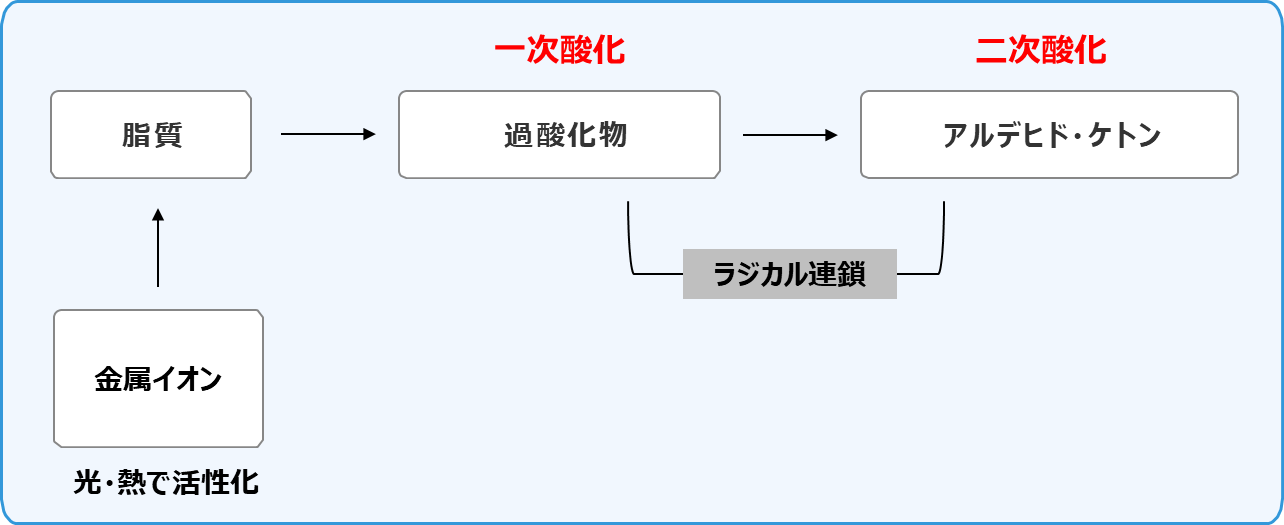
Lipid oxidation does not suddenly produce a dramatic “rancid smell.” Instead, it slowly but steadily erodes product quality. Here we explain the two major stages of oxidation.
Primary Oxidation: The “Silent Change” That Goes Unnoticed
In the first stage of oxidation, unsaturated fatty acids such as DHA and EPA react with oxygen and turn into peroxides. At this point, there is little to no visible or olfactory change, ranging from odorless to only a faint off-note.
However, the peroxide value (POV) already indicates that deterioration has begun, and if oxidation continues, flavor and nutritional quality will also be affected.
Secondary Oxidation: Rancid Odor and Discoloration Become Visible
The next stage is secondary oxidation. Here, the peroxides break down and generate strongly odorous compounds such as aldehydes and ketones.
At this stage, the product may develop the familiar smell of oxidized oil or a metallic note, and the surface of the pet food may discolor to a yellowish-brown hue. By this point, pet owners are much more likely to notice that something is wrong.
In this way, lipid oxidation progresses through a two-step process: from “odorless” to “off-odor.” That is why oxidation control must extend from manufacturing to storage, packaging, and even post-opening preservation methods in order to avoid the situation where “by the time you notice it, it is already too late.”
What Packaging Specifications Help Prevent Oxidation?
| Packaging Structure | Typical Film Composition | OTR (cc/m²·day) at 23°C / 0% RH | WVTR (g/m²·day) | Oxidation Protection Level |
|---|---|---|---|---|
| Monolayer PE (general grade) | 60µm PE | 1,500–2,000 | 6–7 | ★☆☆☆☆ |
| Two-layer PET/PE | 12µm PET / 60µm PE | 100 | 4–5 | ★★☆☆☆ |
| Aluminum vapor-deposited (VMPET/PE) | 12µm VMPET / 60µm PE | 1.0–2.0 | 1.0 | ★★★★☆ |
| Transparent high-barrier (PET/EVOH/PE) | 12µm PET / 15µm EVOH / 60µm PE | 0.5–2.0 | 0.5–1.0 | ★★★★☆ |
| Aluminum foil (PET/AL/PE) | 12µm PET / 7µm AL / 60µm PE | 0 | 0 | ★★★★★ |
There are major differences in barrier performance among the main packaging structures used for pet food.
Monolayer PE Structure
The most common and inexpensive material is a single-layer 60µm PE (polyethylene) structure. However, this type has an extremely high oxygen transmission rate (OTR) of 1,500–2,000 cc/m²·day and a high water vapor transmission rate (WVTR) of 6–7 g/m²·day, making the oxidation risk very high. It may be used for low-cost products with short distribution cycles, but it is not suitable for long shelf life or products with high fat content.
Two-Layer PET/PE Structure
This two-layer structure uses PET as the outer layer to provide a modest improvement in barrier performance. Its OTR is around 100 cc/m²·day and its WVTR is 4–5 g/m²·day, which offers a moderate level of protection.
While it balances cost and performance reasonably well, it is generally limited to room-temperature, short-term applications and may be insufficient for exports or long-term storage.
Aluminum Vapor-Deposited Structure
This structure uses PET with vacuum-deposited aluminum (VMPET), combining an attractive appearance with good barrier properties. With an OTR of 1.0–2.0 cc/m²·day and a WVTR of approximately 1.0 g/m²·day, it provides significantly better protection than transparent films.
It also offers good cost efficiency and processability, making it a common choice for premium product lines and export packaging.
Transparent High-Barrier Structure
This is a transparent high-barrier structure that uses EVOH (ethylene vinyl alcohol) as an intermediate layer. It offers an OTR of 0.5–2.0 cc/m²·day and a WVTR of 0.5–1.0 g/m²·day, delivering performance close to that of aluminum vapor-deposited structures while allowing the product to remain visible inside the package.
It is especially suitable for premium brands that want to showcase the product or emphasize visual design.
Aluminum Foil Structure
The most powerful option for oxidation control is the three-layer PET/aluminum foil/PE structure. Both OTR and WVTR are theoretically close to zero (actual measured values are approximately zero), offering the highest level of protection against light, oxygen, moisture, and odor.
Although this structure is more expensive and requires care to avoid flex cracking or pinholes, it is the safest option under the most demanding conditions, such as export, long-term storage, or high-fat formulations.
Design Features That Make a Difference in Preventing Oxidation
It is not enough simply to choose a bag with good barrier properties. The package must also be designed so that oxygen does not enter the bag in the first place.
Set Numerical Targets for Barrier Performance
Oxidation progresses as a function of oxygen × temperature × time. For products intended for export or storage for more than six months, the goal should be to keep OTR below 1.0 cc/m²·day.
Remove Oxygen with Nitrogen Flushing or Oxygen Absorbers
By filling the package with nitrogen to replace oxygen (“gas flushing”) or using oxygen absorbers, the oxygen level inside the package at the time of sealing can be kept below 1.0%.
There are also increasing cases where one-way valves—commonly used in coffee packaging—are being adapted to allow oxygen to escape while preventing outside air from entering.
Do Not Underestimate Heat Seal Quality
The strength and precision of the heat seal used to close the bag are also extremely important. In pet foods with higher fat content, oil can seep into the seal area and create pinholes. To prevent this, it is effective to use a wider seal width and a bottom gusset with a double-seal structure.
Packaging is not merely a visual element or a container. It is the final line of defense that protects the quality of the contents. If packaging specifications are neglected, even the most carefully designed recipe and nutritional profile can be compromised.
For brands targeting overseas markets or the premium segment in particular, barrier packaging design is a key point of differentiation. Packaging specifications should be treated as part of the product’s quality assurance.
Real Packaging Trouble Cases
Even when the importance of oxidation control is understood, oversights in packaging can still lead to unexpected complaints and product loss. Below are three real-world types of issues seen in pet food manufacturing, along with the lessons learned and relevant countermeasures.
Case 1: Air Ingress Caused by Poor Heat Sealing
- Background:
One pet food brand received a large number of complaints across an entire production lot, such as “it smelled oxidized as soon as I opened it” and “the color looked off.” Investigation revealed that the heat seal on the bags was inadequate, and the package was not airtight. - Cause:
Incorrect seal temperature and pressure settings during bag-making resulted in insufficient seal strength. In products with high fat content, oil was especially likely to seep into the seal area, causing pinholes and delamination. - Impact:
The entire lot had to be voluntarily recalled and returned, causing major damage to brand credibility.
Lessons and countermeasures
- For high-fat products, use a wider seal width and a double-seal structure.
- Conduct regular seal strength testing on the packaging line and clearly define rejection criteria.
- It is also effective to install equipment that can detect seal defects such as pinholes.
Case 2: Oxidative Deterioration Progressed Within Shelf Life
- Background:
A newly launched premium dog food showed flavor deterioration even before the stated expiration date. Some users reported that “it smelled sour” and “my dog stopped eating it.” - Cause:
To prioritize product visibility, a highly transparent OPP/CPP film structure was used. However, its oxygen barrier was too low for long-term storage. In addition, no oxygen absorbers or nitrogen flushing were used. - Impact:
A large portion of the initial shipment became subject to returns, significantly disrupting sales plans.
Lessons and countermeasures
- When selecting packaging, prioritize barrier performance over appearance.
- Design with a target of OTR ≤ 1 cc/m²·day depending on product characteristics and intended shelf life.
- When necessary, material design should assume the use of gas flushing and oxygen absorbers together.
Case 3: Design Priority Reduced Functional Performance
- Background:
A premium brand adopted packaging with metallic ink to create a luxurious appearance. However, storage stability varied, and after several months many complaints about oxidized odor were received. - Cause:
The metallic ink used reacted chemically with the aluminum vapor-deposited layer, creating pinholes. This significantly reduced barrier performance by increasing contact between the package interior and outside air. - Impact:
A package designed to strengthen the premium image ended up giving the opposite impression by compromising freshness.
Lessons and countermeasures
- When using special printing, always verify compatibility among inks, adhesives, and substrates in advance.
- Avoid structures that print directly onto the barrier layer, and instead consider laminated structures with intermediate layers.
- Even when design is a priority, maintaining barrier performance must come first.
How to Approach Oxidation Control in OEM Manufacturing
In pet food OEM manufacturing, recipe development and price negotiation are, of course, important. However, one often overlooked point is the specification and control of packaging.
Especially for foods containing high levels of fat, product value can be significantly damaged by oxidation unless packaging is included in the design from the start. Below is an overview of how oxidation control should be approached when placing OEM orders.
Preparing Packaging Specifications and Key Points to Confirm
When outsourcing manufacturing to an OEM, it is important to prepare and submit not only a product specification sheet, but also a packaging specification sheet. Clearly defining the following items can help prevent future quality problems:
- Film structure to be used (e.g., PET12/AL7/PE60)
- Measured values for oxygen transmission rate (OTR) and water vapor transmission rate (WVTR)
- Bag-making conditions such as seal width and sealing temperature
- Target residual oxygen concentration inside the bag at filling (e.g., ≤1%)
- Shelf-life settings and accelerated test conditions
- Available packing methods (oxygen absorber insertion, gas flushing, etc.)
Building a Coordination System with Related Companies
Packaging quality cannot be managed by the OEM manufacturer alone. Clarifying who is responsible for what and building a coordination system among all related parties is critical to successful oxidation control.
- Material supplier
Request measured OTR/WVTR data sheets and lot-specific test certificates as proof of barrier performance. If necessary, also request safety test results for inks and adhesives. - Packer (filling and packaging contractor)
Confirm whether they have a system for regular measurement of residual oxygen inside the bag, pinhole inspection, and logging of seal strength. It is also important to check whether they have equipment for vacuum filling or nitrogen gas flushing. - Logistics providers and warehouse operators
Temperature fluctuations during transport and storage also increase oxidation risk. Share operating requirements such as refrigerated or air-conditioned storage, the use of temperature loggers in containers, and procedures to avoid direct sunlight.
Designing with Post-Opening Oxidation in Mind
Even if a product leaves the factory with excellent barrier performance, oxidation will accelerate if air repeatedly enters the package after opening. That is why packaging design should also consider resealability from the user’s perspective.
- Packages with resealing functions
Packaging with secure resealing functions—such as slider zippers, single zippers, double zippers, or hook-and-loop closures—is ideal. - Smaller portions and right-size design
It is also effective to divide the product into smaller packs of 1 kg or less, or to sell it in a multi-pack box format, taking both consumption speed and oxidation risk into account.
Checklist: Oxidation Control Items to Confirm When Placing an OEM Order
| Item | Recommended Value / Checkpoint |
|---|---|
| Packaging film structure | Example: PET/Al/PE, PET/EVOH/PE, etc. |
| Oxygen transmission rate (OTR) | ≤ 1 cc/m²·day |
| Water vapor transmission rate (WVTR) | ≤ 1 g/m²·day |
| Heat seal strength | ≥ 40 N/15 mm |
| Oxygen absorber | Determine based on product characteristics |
| Resealability | Zipper closure or small-pack structure |
| Warehouse storage conditions | Below 25°C and protected from light |
Oxidation control is not just about the manufacturing recipe. It is a comprehensive design issue that includes packaging, distribution, and even storage after opening. Rather than leaving everything to the OEM, it is important to clearly define what your company needs to specify in order to protect product stability and brand value.
A packaging OEM manufacturer that can design quality assurance across the entire chain—recipe, packaging, and distribution—is the kind of long-term partner you can truly trust.
OEM Packaging Manufacturing Support

To create packaging that truly protects premium pet food, specialized knowledge and practical experience are required—not only in material selection, but also in structural design, gas flushing, and resealable features.
Our company provides comprehensive OEM manufacturing support that covers not only raw materials but also packaging materials and bag-making specifications. We can propose the most suitable design based on your needs, including export specifications, long-term storage solutions, and optimized barrier performance.
Main Packaging Formats We Handle
- Pillow bags (flat pouches)
- Gusset bags (side gusset bags)
- Stand-up pouches (bottom gusset)
- Resealable stand-up pouches with zipper
Information to Prepare
To help us provide more specific proposals during consultation, it would be helpful if you could prepare the following information:
- Product characteristics of the pet food to be used (fat content, target shelf life, etc.)
- Planned content volume (e.g., 1 kg, 3 kg, etc.) and package shape (gusset bag, stand-up pouch, etc.)
- Desired barrier performance and packaging specifications (e.g., target OTR, whether to use oxygen absorbers, resealable function)
- Planned sales countries and transportation methods (domestic or overseas, ambient or refrigerated, etc.)
- Preferred design direction (printed or unprinted, design-focused or function-focused)
Feel Free to Contact Us
Whether you want to strengthen branding through packaging, are concerned about oxidation with your current pouch, or need support from the specification sheet stage, we can offer practical proposals based on real OEM production experience.