

 Shun Nagai
After one product succeeds, the next move is often unclear. How should the second and third products be developed? Why do price tiers start to feel inconsistent? Why does the brand world seem to weaken each time a new product is added?
Many product planning managers face these concerns when considering a multi-product lineup.
This article outlines a practical framework for designing SKU structure, price tiers, and a consistent brand world in the context of pet food OEM development. By the end, the goal is to help you explain your next one to three SKUs through three layers: role, price ladder, and brand world.
What You Will Learn
- SKUs should be designed not only by price tier, but by role: Hero, Volume, Halo, and Bridge.
- Following the right expansion sequence helps reduce brand inconsistency and internal cannibalization.
- Price tiers should be organized using three levels: entry, core, and premium, preferably on a unit-price basis.
- A brand world is built through consistency across claims, design, and price range.
- For overseas OEM production, the manufacturing country should be selected based on the strategic necessity of each SKU.
Why Product Lineup Design Matters
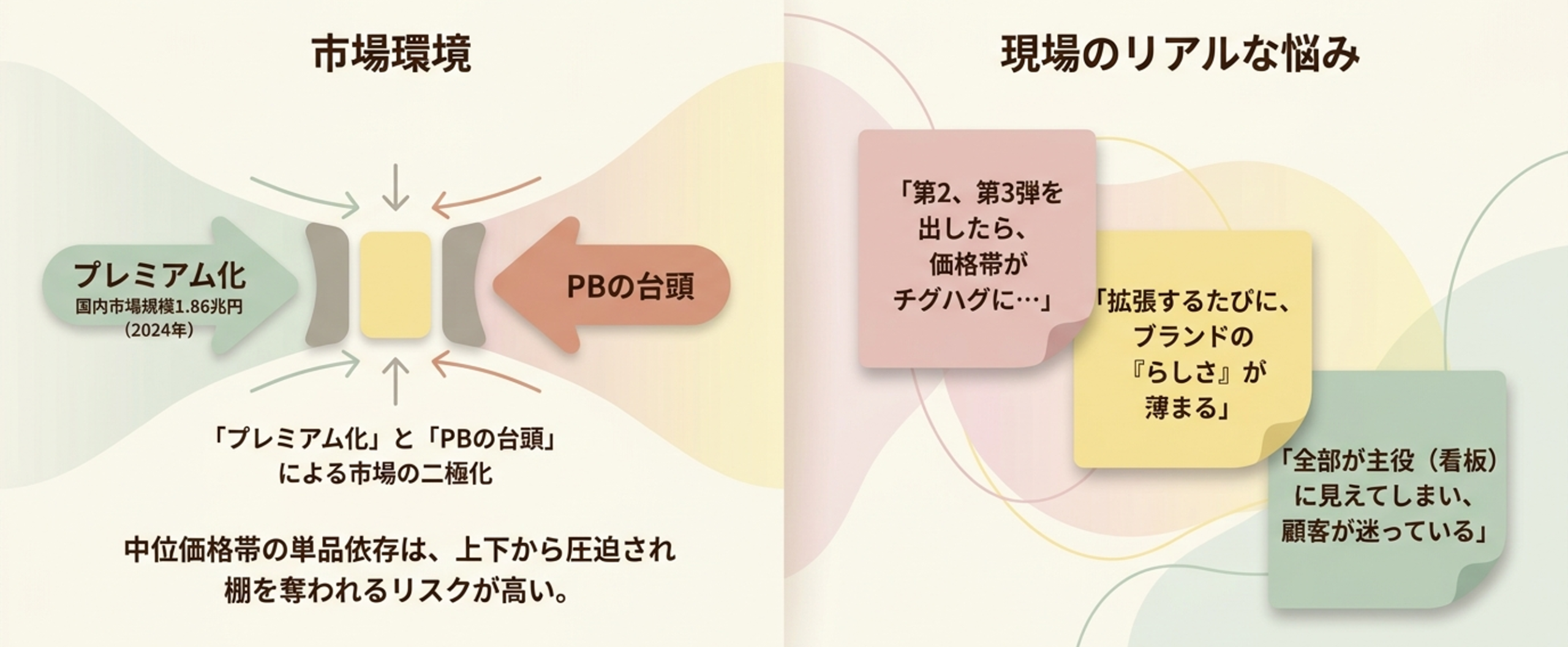
The pet food market is moving in three directions at once: premiumization, functional claims, and D2C growth. As a result, it is becoming structurally difficult to sustain a brand with one successful product alone. Brands that can present a coherent “world” across multiple SKUs are better positioned to maintain customer touchpoints across retail shelves, e-commerce, and subscription channels.
In Japan, Yano Research Institute announced that the total pet-related market reached JPY 1.8629 trillion in FY2024, up 4.5% year on year, and is forecast to reach JPY 1.9257 trillion in FY2025. The report identifies high-value-added products as a key driver of market expansion (Source 1). In terms of pet ownership in Japan, the combined dog and cat population continues to maintain a meaningful scale, suggesting that the quantitative foundation of the market remains relatively firm (Source 17).
Euromonitor estimates the global pet care market in 2025 at approximately USD 207 billion and analyzes that value growth is being supported by less price-sensitive consumers who place importance on functional and cognitive benefits. It also reports that 68% of Gen Z and 69% of millennials consider pets to be family members, making pet humanization a foundation for premiumization (Source 2).
At the same time, private-label pet food is also growing rapidly. Some market research firms take an optimistic view of medium- to long-term growth in private-label pet food. IndexBox estimates that the market will expand from USD 2.55 billion in 2025 to USD 12.24 billion in 2035, representing a CAGR of 17.0% (Source 3). Market forecasts should be treated as estimates, but the direction of structural change is also discussed in a similar way by Pet Food Industry (Source 4).
Pet Food Industry also argues that the growth of private-label pet food is structurally pressuring the mid-price segment, pushing the market toward polarization between private label and premium specialist brands (Source 4). A brand that has only one core SKU in the mid-price range may find it increasingly difficult to explain its reason for being on the shelf when squeezed from both above and below.
In the D2C space, The Farmer’s Dog in the United States reportedly grew to an estimated USD 1.2 billion scale in 2024 and has expanded from its core business into adjacent categories such as dental products and lifestyle goods. Based on what can be observed externally, this is a useful example of expanding into surrounding categories while keeping a Hero product at the center (Source 5).
The Four Roles of SKUs
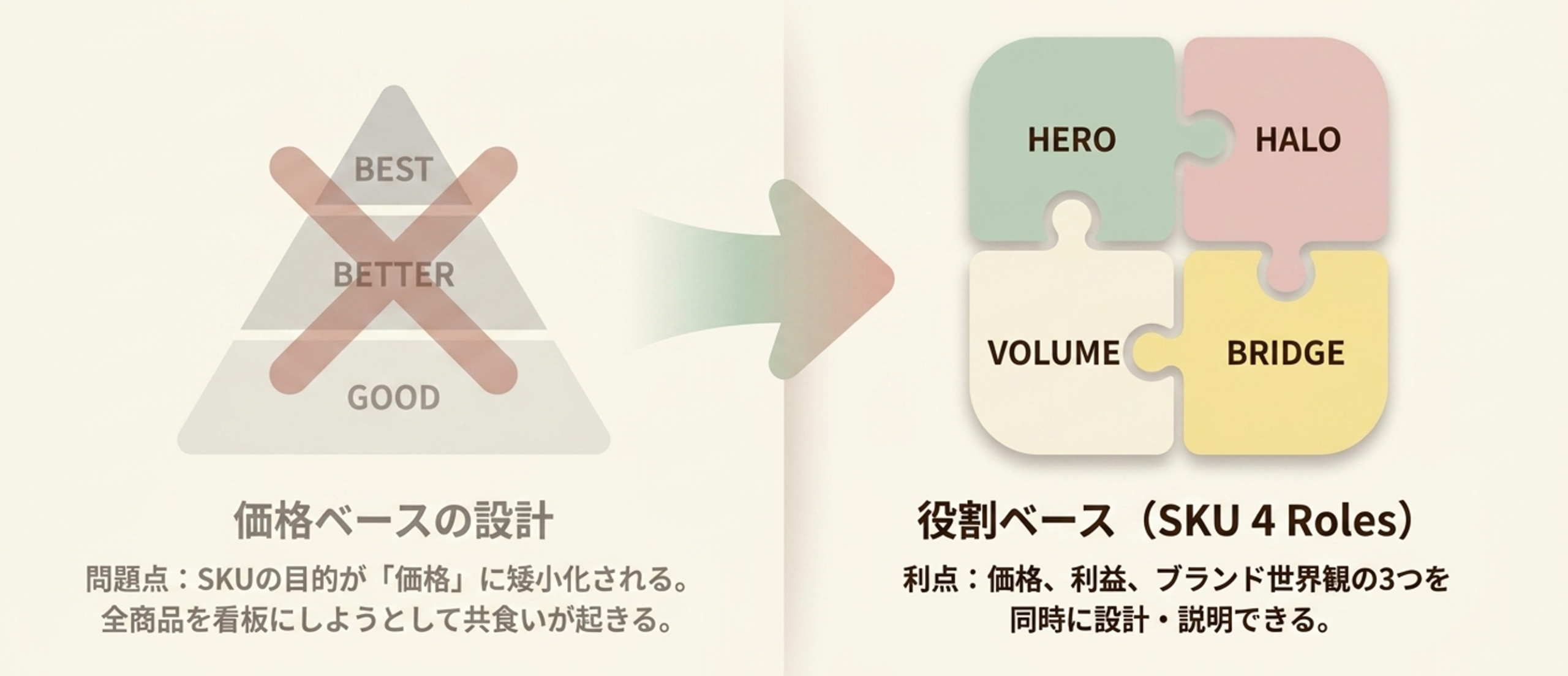
The Good / Better / Best pyramid is useful for organizing price tiers. However, by itself, it does not clearly show what role each SKU plays within the brand. Lineup decisions become easier when SKUs are categorized not only by price, but also by whether they are designed to win awareness, support sales volume, elevate the brand world, or create an entry point.
In this article, to make OEM lineup design easier to discuss, SKU roles are organized into four categories: Hero, Volume, Halo, and Bridge. This is not an industry-standard classification. Rather, it is a practical way to clarify why each SKU exists when designing a multi-SKU lineup.
- SKU:
The smallest inventory management unit.
Different flavors and different pack sizes are also treated as separate SKUs. - Hero SKU:
The flagship product that represents the brand.
Triple Whale describes the Hero product as the “Atomic Unit” of the business, serving both as a major source of revenue and as a driver for related products (Source 6). - Volume SKU:
A SKU that supports profit through purchase frequency, repeat purchasing, and absolute sales volume.
It is generally positioned in the core price range. - Halo SKU:
A high-price, high-claim SKU that symbolizes the brand world and expertise.
Its role is less about sales volume and more about lifting the perceived value of other SKUs. - Bridge SKU:
A SKU designed to create an entry point or trial experience, such as a small pack, lower-price format, or gift-use product.
Table 1. Four SKU Roles
| SKU Role | Main Purpose | Example Price Range | Contribution to the Brand |
|---|---|---|---|
| Hero | Awareness building and differentiation | Core to slightly above core | Recall and representativeness |
| Volume | Repeat purchase and profit support | Core range | Cash flow |
| Halo | Presentation of brand world and expertise | Premium range | Brand elevation |
| Bridge | Trial, entry point, and gift use | Entry range / small pack | Lower CAC (Customer Acquisition Cost) |
A lineup that does not define roles tends to force every SKU to act as Hero, Volume, Halo, and Bridge at the same time. The result is a situation where five “Hero-like” SKUs are placed side by side, and no one can tell which product is truly the flagship. This is the real reason why a brand world starts to feel diluted each time the lineup expands.
McKinsey notes that CPG manufacturers can potentially improve net sales by 1 to 4 percentage points, margins by 3 to 6 percentage points, and asset productivity by 10 to 25% even after reducing SKUs by 25%. The implication is that profitability is driven not by the number of SKUs, but by the clarity of each SKU’s role (Source 7).
For mid-sized manufacturers and D2C brands, it is often more common to expand SKUs within a single brand than to launch multiple separate brands. In that case, separating the roles of Hero, Volume, Halo, and Bridge within the same brand makes it easier to organize the overall lineup (Source 8).
The Three-Layer Structure Behind a Product Lineup
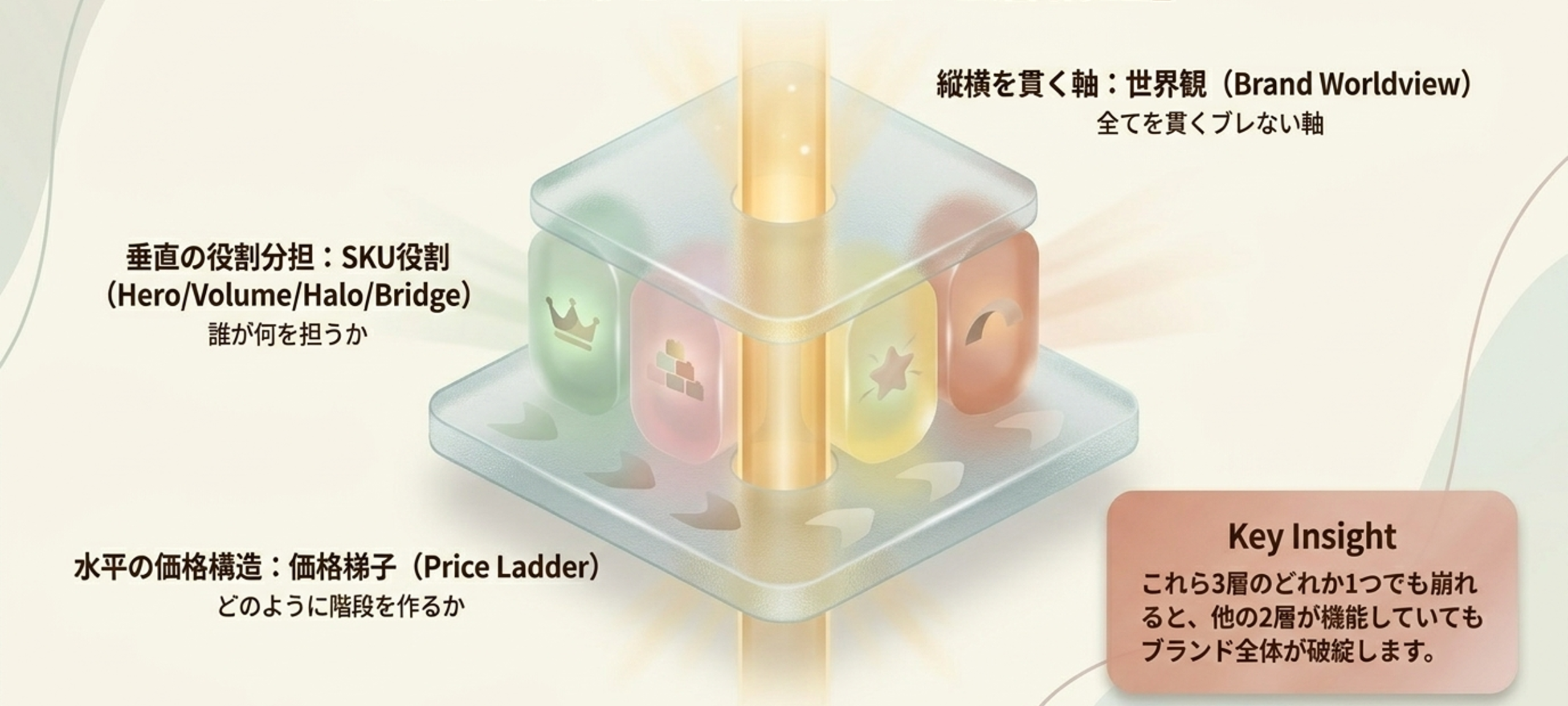
Lineup design becomes easier to manage when viewed through three layers: SKU role, price ladder, and brand world.
SKU role clarifies why each product exists.
The price ladder checks whether the price tiers connect naturally.
The brand world checks whether the brand identity remains consistent across all SKUs.
If any one of these three layers breaks down, the persuasiveness of the entire lineup weakens.
SKU Role: Vertical Role Allocation
The first question is: When describing this brand in one sentence, which SKU should be placed at the front?
In SKU role design, products should not simply be arranged by sales ranking or price ranking. Instead, they should be organized vertically according to their roles: the product that represents the brand, the product that supports sales volume, the product that elevates the brand world, and the product that creates the entry point.
The SKU with the highest sales is not always the Hero SKU. For example, a SKU may support volume through subscription purchases but still be difficult to use when explaining the brand’s uniqueness or worldview. In that case, it is more natural to define it as a Volume SKU rather than a Hero SKU.
If a brand expands while the Hero SKU remains unclear, most of the new products tend to become variations of the Volume SKU. On shelves or e-commerce pages, the lineup then looks like a group of similar products rather than a clearly designed brand system.
Price Ladder: Horizontal Price Structure
A price ladder is the practice of arranging entry, core, and premium price tiers with natural step-ups. In pet food, if price points are too close, the difference between products becomes difficult to communicate. If they are too far apart, the products may no longer feel as if they belong to the same brand.
For that reason, a practical starting point is to first set tentative three-level price tiers, then adjust them against each SKU’s role and cost structure.
Price Ladder Benchmarks
When comparing pet food SKUs, use either the price per 100g or the daily feeding cost.
As a guideline:
Core price range: approximately 1.3 to 1.6 times the entry price range
Premium price range: approximately 1.5 to 2.0 times the core price range
The practical point is to check both the gap and the multiplier.
Pet food often includes many pack-size variations, so comparing only the suggested retail price can obscure the real price difference. A 200g small pack, an 800g core product, and a 1.5kg large-size product cannot be evaluated properly based on shelf price alone. Therefore, when designing a price ladder, it is more practical to compare either the price per 100g or the daily feeding cost.
The appropriate multiplier will vary depending on pack size, sales channel, and cost structure. However, using a rough guideline of 1.3 to 1.6 times from entry to core, and 1.5 to 2.0 times from core to premium, makes it easier to check whether the price steps feel natural.
If the gap between entry and premium becomes too large, consumers may start to see the products not as different levels within the same brand, but as products from separate brands.
Brand World: The Expression That Connects Both Axes
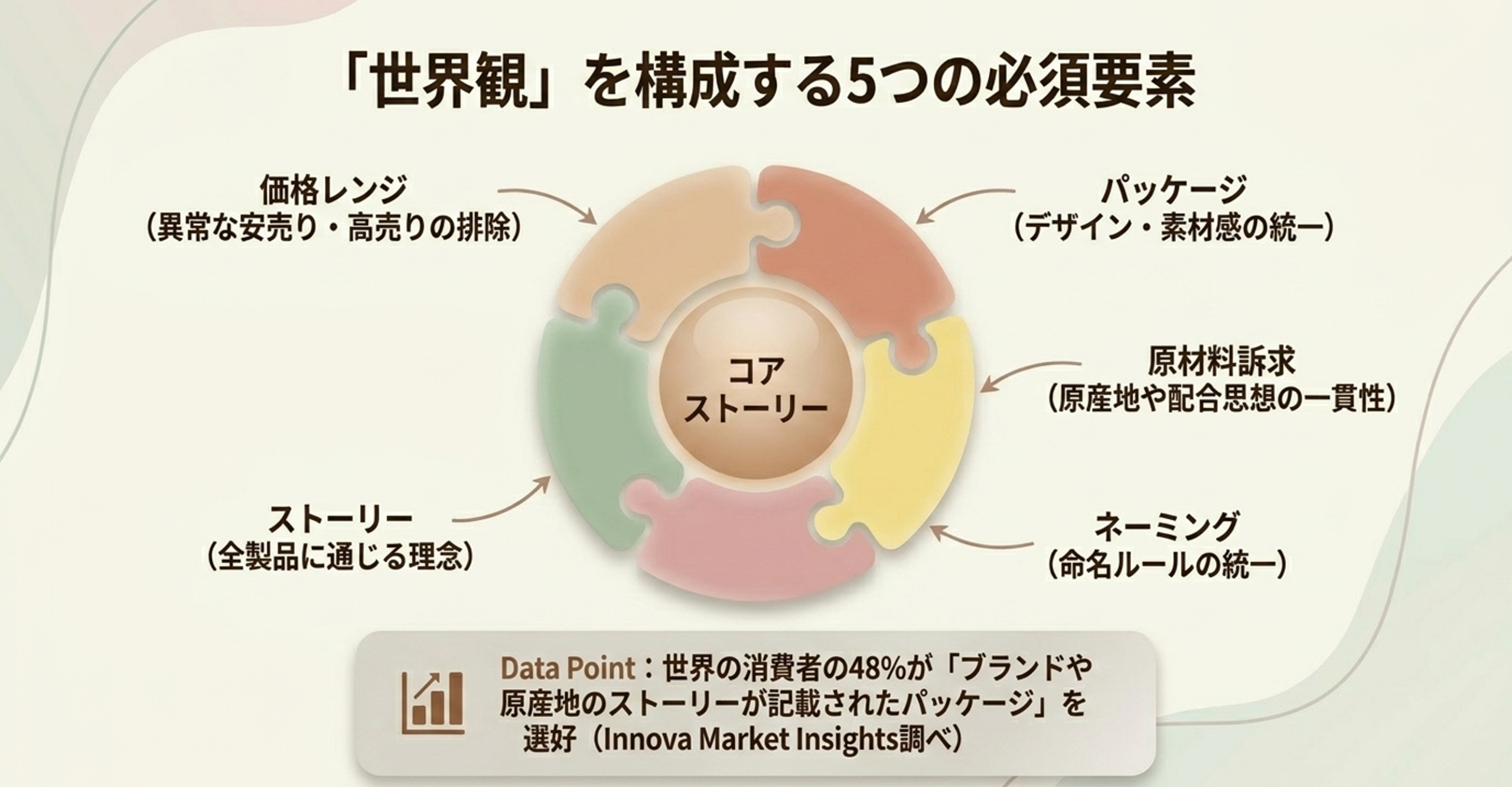
A brand world is created when five elements remain consistent across Hero, Volume, Halo, and Bridge SKUs: packaging, ingredient claims, naming, story, and price range.
According to Innova Market Insights, 48% of global consumers say they want to choose products that show a brand or origin story on the package. This suggests that making the brand world visible is one quantifiable factor in purchase decisions (Source 10).
Three Patterns That Break the Brand World
- One pattern is when only the Halo SKU takes a luxury direction, making the Hero and Volume SKUs look like products from another brand.
- Another is when the Bridge SKU is designed simply to be cheap, causing its ingredient claims to contradict the rest of the lineup.
- A third is when naming rules change every time the lineup expands.
Five Steps for Product Lineup Design
Lineup design can be broken down into five steps:
Step 1: Current lineup diagnosis
Step 2: Role definition
Step 3: Price ladder design
Step 4: Expansion sequence
Step 5: Brand world check
If the order is changed, rework will almost certainly occur later.
Step 1: Current Diagnosis — Relabel Existing SKUs by Role
Start by rearranging current or planned SKUs not by sales ranking, but by role. Any SKU that does not fit one of the four roles should be temporarily classified as an “unclear-role SKU” and reviewed.
Simon-Kucher notes that SKUs without a clear differentiated position are more likely to cause internal cannibalization. Defining the role at the diagnosis stage is therefore a prerequisite for expansion (Source 11).
Step 2: Role Definition — Identify the Missing Role
Next, identify which of the four roles is currently missing.
A brand that has a Hero but no Bridge may struggle with high customer acquisition cost.
A brand that has Volume but no Hero may struggle to create recognition on the shelf.
As a basic rule, expansion should proceed by filling the missing role.
Step 3: Price Ladder — Define the Three Price Ranges Numerically
Once the roles have been clarified, compare the price structure against the earlier benchmarks: core price at approximately 1.3 to 1.6 times entry, and premium price at approximately 1.5 to 2.0 times core.
Then check this against your own cost structure, retail margin, and expected shelf price. A price ladder only works when it is aligned not only with the suggested retail price, but also with the internal P/L structure.
Step 4: Expansion Sequence — Take One Expansion Step at a Time
For D2C and mid-sized brands, this article recommends adding new SKUs one step at a time as a safer approach. Large companies, brands that already control shelf space, or major relaunches may be exceptions.
Mars Petcare reportedly launched 80 core SKUs in four weeks when it introduced James Wellbeloved through D2C. However, this was possible because of the capital strength of a major company. For mid-sized and D2C brands, “one expansion at a time” is more realistic (Source 12).
- Single product stage: Establish the Hero
First, stabilize one Hero SKU. Do not expand until subscription rate and repeat purchase rate begin to accumulate. - Same-theme horizontal expansion
Add pack-size, flavor, or format variations that share the same brand world and formulation philosophy as the Hero SKU. - Different-theme expansion
Add variations based on different functions, such as skin and coat, joint care, or digestive health. - Life-stage expansion
Add variations for adult dogs, senior dogs, puppies, and other customer lifecycle needs.
Step 5: Brand World Check — Five-Element Checklist
Create a list of all SKUs, including the new SKU, and check five elements: packaging, ingredient claims, naming, story, and price range.
If even one element contradicts the other SKUs, return to Step 4 and revise the additional SKU design.
Failure Patterns and Anti-Patterns
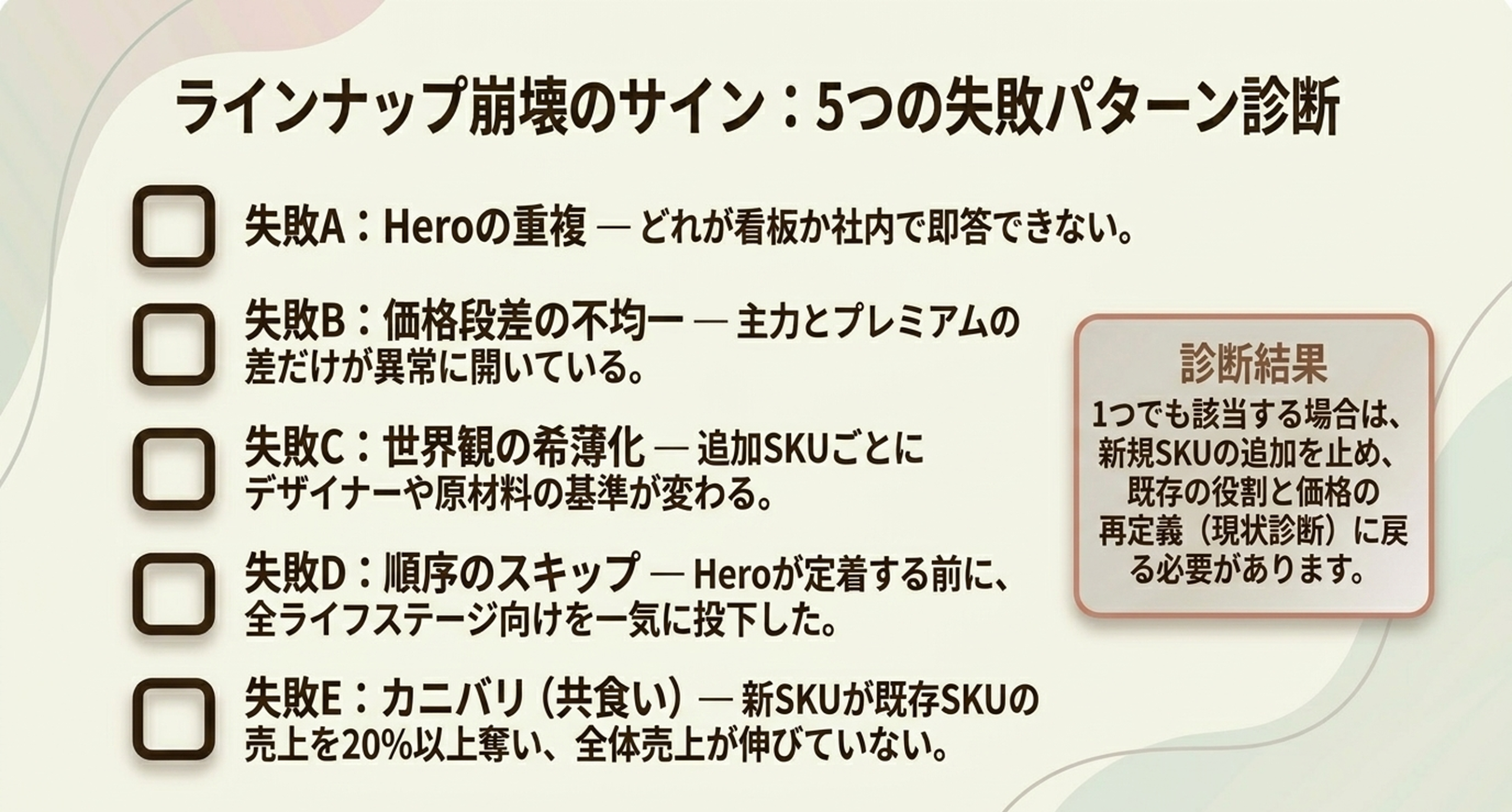
Lineup design failures generally fall into five categories: duplicated roles, uneven price steps, diluted brand world, skipped expansion sequence, and signs of cannibalization.
Failure A: Duplicated Hero SKUs
This occurs when several “potential flagship” products with similar positioning are placed side by side. If the internal team cannot immediately answer which product is the flagship, the Hero role may be duplicated.
For early-stage brands, the principle is to narrow the Hero down to one product.
If multiple flagship products are needed by dog/cat, dry/wet, or age segment, the brand should either clearly separate sub-lines and target segments or consider shifting to a House of Brands structure (Source 8).
Failure B: Uneven Price Steps
This occurs when the gap between entry and core is almost nonexistent, while the gap between core and premium is very large.
Pricefx also notes that when price steps are uneven, the middle tier does not work effectively as a purchasing guide (Source 13).
Failure C: Dilution of the Brand World
This happens when the package designer, claim standards, or ingredient language changes with each expansion, resulting in contradictions across SKUs.
Conducting the Step 5 brand world check before finalizing the additional SKU is an effective way to avoid this issue.
Failure D: Skipping the Expansion Sequence
This occurs when a brand jumps into life-stage expansion — adult, senior, puppy — before the Hero SKU has stabilized.
By contrast, Ritual is often discussed as a case that succeeded through vertical expansion: a single entry point first, followed by the next SKU in line with the customer’s life-stage progression. This suggests the importance of following the proper sequence (Source 14).
Failure E: Signs of Cannibalization
Cannibalization occurs when a new SKU takes sales away from an existing SKU without expanding the overall category.
There is no universal standard for measuring cannibalization, and definitions vary by context. However, in some practical settings, a level at which a new SKU takes approximately 20% or more of sales from an existing SKU is treated as a caution signal (Source 15).
The actual decision should be made together with gross profit, new customer ratio, and changes in total category sales.
If monthly sales of an existing SKU decline after the launch of a new SKU, three points should be reviewed: price steps, claim axis, and sales channel.
Thinking Through Two Models
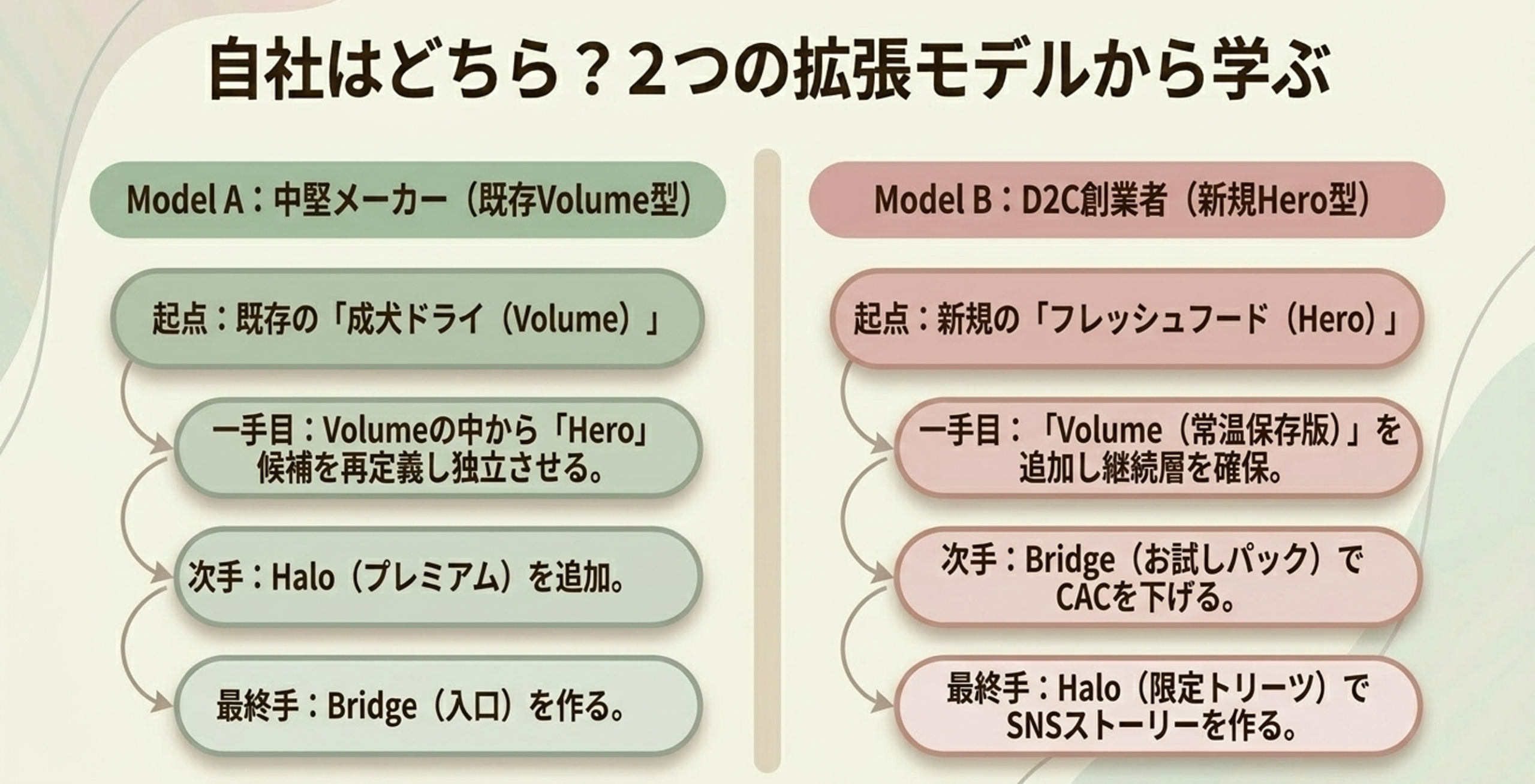
Abstract frameworks become easier to use when applied to model cases. The following are fictional brand settings and do not represent the strategies of actual brands.
Model A: Mid-Sized Pet Food Manufacturer
- Existing product:
1.5kg dry complete food for adult dogs, positioned in the core price range as a Volume SKU. - Additional SKU 1: Hero SKU
An 800g functional dry food for small dogs, positioned slightly above the core price range. The nutritional design is developed backward from body size, activity level, and care points specific to ownership conditions. - Additional SKU 2: Halo SKU
A 500g premium dry food for small dogs, positioned in the premium range. The use of New Zealand or Australian ingredients strengthens the brand world. - Additional SKU 3: Bridge SKU
A 200g small pack or three-pack gift set, positioned in the entry range. It serves as an entry point for subscriptions, gifting, and sampling.
For mid-sized manufacturers that already have a Volume SKU, it is often more realistic to redefine a Hero candidate from within the existing Volume products rather than create an entirely new Hero from scratch. Model A assumes this pattern.
The roles are filled in the order of Volume → Hero → Halo → Bridge. If the price ladder is designed on a price-per-100g basis as entry : core : premium = 1 : 1.5 : 2.7, the spacing can remain coherent even after adjusting for pack-size differences. The design should be based on unit price, not the suggested retail price itself.
Model B: D2C Brand Founder
- Existing product:
chilled fresh food subscription for adult dogs, positioned as the Hero SKU. - Additional SKU 1: Volume SKU
A shelf-stable product for adult dogs, designed to convert customers who are not ready to commit to chilled food into repeat purchasers. - Additional SKU 2: Bridge SKU
A two-week trial pack, designed to reduce CAC and create an experience before subscription. - Additional SKU 3: Halo SKU
A limited-ingredient single-product treat, designed to carry a story that can be shared on social media.
For D2C brands, it is generally more realistic to add products one by one after the Hero has stabilized through repeat purchase. Triple Whale also presents “do not start the second product until the Hero is stable” as one safe way of thinking (Source 6).
Using Overseas OEM Bases by SKU Role
In practice, the manufacturing country should be selected by working backward from the strategic necessity of each SKU. Table 2 in the Tables section summarizes general tendencies. In actual projects, the decision can vary significantly depending on ingredient availability, MOQ, and logistics conditions.
Table 2. Example Overseas OEM Bases by SKU Role
| SKU Role | Potential Overseas OEM Base | Reason for Role-Based Selection |
|---|---|---|
| Hero | New Zealand / Australia / Canada | Strengthening ingredient story and brand-world expression |
| Volume | Thailand / Japan | Scale, logistics, and stable continuous supply |
| Halo | New Zealand / Australia | Alignment with premium positioning and origin claims |
| Bridge | Thailand / Japan | Small-lot trials and short lead-time response |
The country positioning in Table 2 reflects general tendencies we consider when evaluating OEM manufacturing networks. Thailand’s position as a global pet food export hub can be confirmed through primary materials (Source 16). The characteristics of factories in New Zealand, Australia, and Canada — such as grass-fed, seafood-based, and novel-protein strengths — are tendencies we have organized through discussions and project evaluations with OEM factories.
When each SKU role is separated by whether it prioritizes “brand world enhancement” or “stable supply,” the discussion around manufacturing country selection becomes much easier to organize.
SKU Design Worksheet
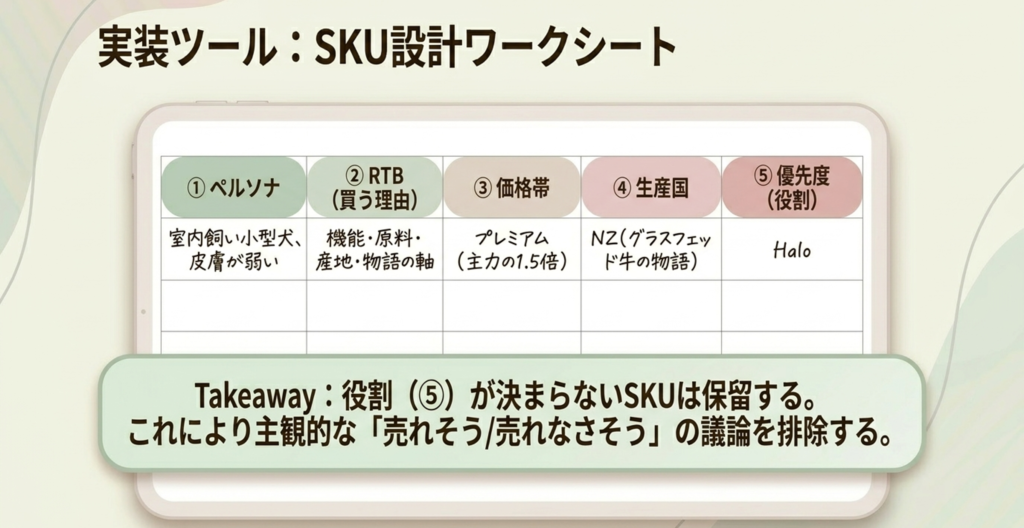
When discussing lineup design internally, it is useful to convert the framework into a simple five-column worksheet. This compresses Steps 1 to 5 into a single sheet and gives all stakeholders a common table for discussion.
Table 3. SKU Design Worksheet
| Column | What to Enter | Practical Tip |
|---|---|---|
| 1. Persona | Target customer profile, including age, ownership environment, and concerns | Make it specific, such as “one small indoor dog with sensitive skin,” rather than only “woman in her 30s” |
| 2. RTB (Reason to Believe) | The reason customers should buy the product | Clarify whether the axis is function, ingredient, origin, or story |
| 3. Price Tier | Whether the SKU belongs to entry, core, or premium | Add the multiplier versus existing SKUs |
| 4. Manufacturing Country | Which production base will manufacture the SKU | Explain the reason in one sentence from the perspectives of ingredients, regulations, and brand world |
| 5. Priority | Role: Hero, Volume, Halo, or Bridge | Put any SKU whose role cannot be decided on hold |
Once this worksheet is used, structural issues become easier to identify in internal meetings. For example:
“This is supposed to be a Volume SKU, but the package is being developed like a Hero SKU.”
“This SKU is meant to play a Halo role, but the price ladder still places it in the core range.”
Without a structured discussion, meetings tend to drift into subjective opinions such as “I like it / I don’t like it” or “It seems like it will sell / it does not seem like it will sell.”
The manufacturing country column is the one that most requires external expertise. To discuss each country’s MOQ, regulations, and import/export operations in detail, primary materials and practical operational knowledge need to be combined.
Summary: The Three Essentials
Essential 1: The core of SKU design is to decide the role before the price.
The Good / Better / Best pyramid alone only allows price discussion. When the lineup is reorganized using the four roles of Hero, Volume, Halo, and Bridge, the lineup begins to function as a system that creates a brand world.
Essential 2: Moving one expansion step at a time is the practical way to protect the brand world.
Start from Hero stability, then proceed through single product → same-theme horizontal expansion → different-theme expansion → life-stage expansion. The more the sequence is skipped, the higher the risk of brand dilution and internal cannibalization.
Essential 3: Price ladder and the five brand-world elements must be checked at the same time.
Even if the price multipliers are well designed, the brand world will not hold if the packaging and story are fragmented. Checking the five elements on one checklist is the minimum requirement for managing multiple SKUs.
FAQ
Q1. Should the second SKU be launched in the same price range as the Hero, or should it be shifted to a different price range?
In general, the standard approach is to begin with same-theme horizontal expansion, such as pack-size or flavor variations, while maintaining the same brand world and price range as the Hero.
A second SKU in a different price range should usually be designed as either a Halo or Bridge SKU. However, if the price tier is shifted before Hero repeat purchase and recall have stabilized, customer perception may become fragmented.
A safer sequence is to first stabilize the Hero’s repeat purchase rate, then move on to a second SKU with a different price tier.
Q2. Is a premium Halo SKU worth launching even if it is not highly profitable?
If viewed only at the individual SKU level, a Halo SKU can often have thin marginal profit. However, the role of a Halo SKU is to create a halo effect that raises the perceived value of other SKUs.
It may positively influence the selling price and repeat purchase rate of Hero and Volume SKUs. Therefore, the Halo SKU should not be evaluated only by its own P/L, but by its contribution to overall average order value and LTV (Customer Lifetime Value). That said, definitive numerical claims should be avoided, and the effect should be verified using internal data.
Q3. What should mid-price brands under pressure from private label do first?
Multiple sources suggest market polarization (Sources 3 and 4). A mid-price brand without a Halo SKU may be directly exposed to price pressure from private label.
In practice, two actions are relatively easy to begin with:
First, redefine the Hero as a specialist product for a specific segment within the mid-price range.
Second, add one Halo SKU to create an upward brand world.
Q4. How should a D2C brand decide when to launch a second product?
As a general industry guideline, the starting point for considering a second product is when the Hero product has stable sales and a certain scale of customers are making repeat purchases (Source 6).
Signs such as worsening subscription cancellation rate, a sharp increase in CAC, or slowing growth of the Hero product can also be used as indicators that preparation for a second product should begin.
Q5. If multiple overseas OEM bases are used, will the brand world become fragmented?
Whether the brand world becomes fragmented depends on the fit between SKU role and manufacturing country.
For example, if a Halo SKU that highlights New Zealand ingredients is produced in New Zealand, while a Volume SKU designed for scale is produced in Thailand, the brand world does not necessarily become fragmented. As long as the packaging, ingredient claims, and story of each SKU can be explained through the strategic necessity of its role, the lineup can remain coherent.
On the other hand, if the manufacturing country is explained only in terms of cost, consumers may perceive a gap between what the brand says and how the product is made.
Q6. After increasing too many SKUs, how should a brand decide which ones to reduce?
McKinsey notes that, in a typical CPG company, 35% of SKUs contribute nothing to marginal profit, while the bottom 15% destroy cumulative gross profit (Source 7).
In practice, SKU reduction should be prioritized based on three conditions:
SKUs whose role cannot be explained
SKUs with clear signs of cannibalization
SKUs whose repeat purchase rate has dropped significantly over the past 6 to 12 months
Role definition is not only useful for expansion. It also becomes a standard for deciding which SKUs to discontinue.
Moving Into the Implementation Phase
To turn this framework into implementation, the next step is to create a working draft that lists the expected SKUs — Hero, Volume, Halo, and Bridge — together with the manufacturing country, ingredient concept, and price tier for each SKU.
For brands using multiple production bases, issues such as MOQ, regulations, and import/export operations vary by country and can quickly become too complex for internal discussion alone.
First Reach Thailand supports product planning, recipe development, production management, packaging, and international logistics through its OEM manufacturing factory network in Thailand, New Zealand, Australia, and Canada. This includes operational design referring to AAFCO and FEDIAF guidelines, as well as concept development based on dry food, freeze-dried food, and functional ingredients.
If your multi-SKU lineup design has moved to the next stage, preparing a draft SKU list before contacting us through the free consultation form will make it easier to organize the starting point for discussion.
Email
nagai@first-reach.org
We reply within 1 business day.
Phone
+66 (0)6-1457-4310
Weekdays 8:00〜17:00
Web Form
https://first-reach.org/en/contact/
Available 24/7 via smartphone or PC

References and Sources
- 矢野経済研究所「ペットビジネスに関する調査を実施(2025年)」プレスリリース https://www.yano.co.jp/press-release/show/press_id/3906(2026-06-01 取得)
- Euromonitor International “Top Pet Care Trends 2025: Pricing, Premiumisation & Health Focus” https://www.euromonitor.com/article/pricing-pressure-premiumisation-and-pet-health-trends-shaping-global-pet-care-in-2025(2026-06-01 取得)
- IndexBox “Private Label Pet Food Market Forecast Points Higher Toward 2035 Driven by Premiumization and Retailer Brand Loyalty” https://www.indexbox.io/blog/private-label-pet-food-market-forecast-points-higher-toward-2035-driven-by-premiumization-and-retailer-brand-loyalty/(2026-06-01 取得)
- Pet Food Industry “Private label pet food growth beating out name brands” https://www.petfoodindustry.com/pet-food-marketing-and-branding/article/15752886/private-label-pet-food-growth-beating-out-name-brands(2026-06-01 取得)
- Contrary Research “The Farmer’s Dog Business Breakdown & Founding Story” https://research.contrary.com/company/the-farmers-dog(2026-06-01 取得)
- Triple Whale “Why Your Hero Products Should be the Atomic Unit of Your Business” https://www.triplewhale.com/blog/hero-products-dtc(2026-06-01 取得)
- McKinsey & Company “Simpler is (sometimes) better: Managing complexity in consumer goods” https://www.mckinsey.com/industries/consumer-packaged-goods/our-insights/simpler-is-sometimes-better-managing-complexity-in-consumer-goods(2026-06-01 取得)
- Harvard Business School “Brand Portfolio Strategy and Brand Architecture – Background Note” https://www.hbs.edu/faculty/Pages/item.aspx?num=51600(2026-06-01 取得)
- Stripe “Tiered pricing 101: A guide for a strategic approach” https://stripe.com/resources/more/tiered-pricing-101-a-guide-for-a-strategic-approach(2026-06-01 取得)
- Innova Market Insights “Global packaging trends in brand identity and storytelling” https://www.innovamarketinsights.com/trends/global-packaging-trends-in-brand-identity-and-storytelling/(2026-06-01 取得)
- Simon-Kucher “What to consider for your product line extension strategy” https://www.simon-kucher.com/en/insights/what-consider-your-product-line-extension-strategy(2026-06-01 取得)
- Econsultancy “Six lessons from Mars Petcare’s dive into D2C during the pandemic” https://econsultancy.com/mars-petcare-d2c-ecommerce/(2026-06-01 取得)
- Pricefx “Pricing Ladders in Retail – 5 Tips for Great Execution” https://www.pricefx.com/learning-center/pricing-ladders-in-retail-5-tips-for-great-execution(2026-06-01 取得)
- Hypersku “What is a Product Line? The Strategy Guide for DTC Brands” https://hypersku.com/v2/blog/dtc-product-line-strategy(2026-06-01 取得)
- CEO Today Magazine “Trade Promotion Optimization 2026: Solve Cannibalization & Maximize Portfolio Profit” https://www.ceotodaymagazine.com/2026/02/solving-the-cannibalization-puzzle-with-portfolio-wide-optimization/(2026-06-01 取得)
- VNU Asia Pacific “Pet Food Sourcing in Thailand: A veritable alternative in times of global production shortages” https://www.vnuasiapacific.com/2022/06/24/pet-food-sourcing-in-thailand-a-veritable-alternative-in-times-of-global-production-shortages/(2026-06-01 取得)
- 一般社団法人ペットフード協会「全国犬猫飼育実態調査」(2024年版) https://petfood.or.jp/data-chart/(2026-06-01 取得)