

 Shun Nagai
Freeze-drying is a processing method that enables long-term shelf stability while preserving the nutritional value and flavor of raw ingredients to the greatest extent possible. This guide provides pet food developers with a structured overview of key manufacturing steps, design considerations, and current best practices for ensuring quality and safety.
What Is Freeze-Drying?
Freeze-drying, or lyophilization, is a technology in which food is first frozen and then dried under vacuum by sublimation, where ice changes directly from a solid to a vapor.
Unlike conventional hot-air drying, freeze-drying does not rely on high temperatures, so the food’s color, aroma, flavor, and nutritional value are largely preserved. For example, Japan’s Ministry of Agriculture, Forestry and Fisheries has reported that because no high heat is applied during the drying process, nutrients such as vitamins are less likely to be damaged.
By removing moisture, microbial growth is suppressed, allowing products to be stored at room temperature for extended periods without the need for added preservatives. For this reason, freeze-dried foods are widely used in applications ranging from emergency rations to space food.
Key Benefits of Freeze-Drying
Retention of Nutrients and Flavor
Because no high-temperature heating is involved, nutrient degradation is minimal, and vitamins and amino acids remain largely intact. The ingredient’s natural aroma and umami are also preserved, helping maintain excellent palatability.
Preservation of Shape and Structure
Since the product is dried in a frozen state, its volume and shape change very little, and cellular damage is minimized. Meat and vegetables can therefore retain much of their original appearance.
High Rehydration Performance
After drying, countless microscopic pores remain inside the food where the ice crystals once were. As a result, the product quickly returns to a near-original state when water or lukewarm water is added. For example, 15 g of dried food can be reconstituted to approximately 50 g.
Long Shelf Life
Because very little moisture remains, typically 5% or less, the product resists spoilage and can generally be stored unopened for two years or more. Since the process is carried out under vacuum, oxidative damage is also reduced, allowing safe storage without preservatives.
Freeze-Drying Manufacturing Process
The freeze-drying process can be broadly divided into five stages: pretreatment, freezing, primary drying (sublimation drying), secondary drying (finish drying), and packaging. Each stage requires precise control of temperature and vacuum, though the overall workflow itself is straightforward. The steps are explained below in sequence.
Freeze-Drying Process Flow
- Pretreatment
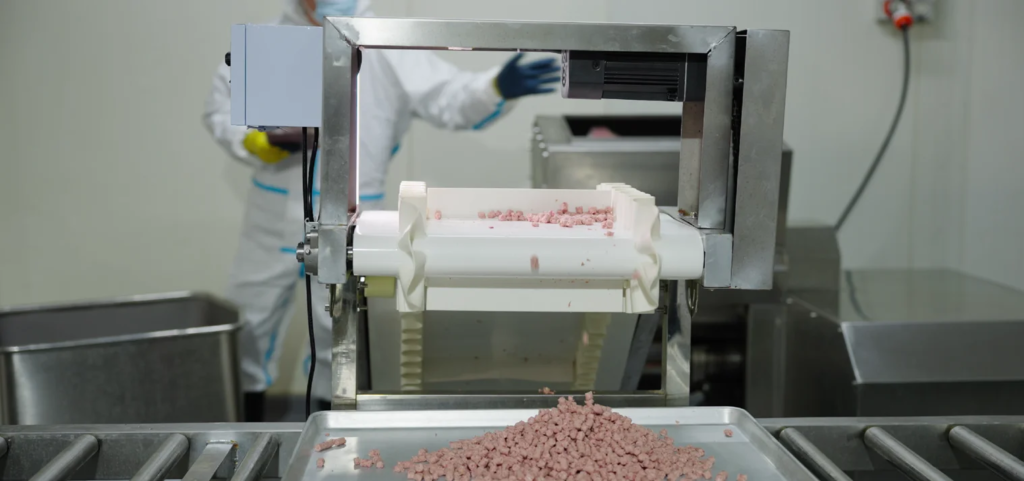
Raw materials such as meat and vegetables are cut or ground as needed, then blended uniformly in a mixer. In freeze-dried dog and cat food, raw meat and organs are often minced and mixed with vegetables, vitamins, and minerals according to the formulation.
After mixing, the material is formed into the desired shape using a pellet machine or molding equipment. Forming the product in advance helps maintain a uniform shape and finish after drying.
To improve safety, some manufacturers apply high-pressure processing (HPP) at the raw material stage. This method uses pressure to inactivate foodborne pathogens and has the advantage of reducing pathogen risk in raw meat without heat treatment.
- Freezing

The pretreated material is rapidly frozen as quickly as possible. In general, it is frozen down to about -30 to -40°C in a freezer. The purpose of freezing is to solidify the material so it does not melt or collapse during vacuum drying, and to enable efficient sublimation.
The size of the ice crystals has a major effect on quality. For example, rapid freezing creates small, fine ice crystals, which cause less cellular damage and are better for preserving nutrients and flavor. However, because the crystals are small, sublimation tends to take longer.
By contrast, slow freezing produces larger ice crystals. Drying can proceed more quickly, but the larger crystals are more likely to damage cell walls, which may impair texture after rehydration.
In pet food, both product texture and nutritional value are important, but production efficiency is also required. Therefore, cooling design must be optimized according to product characteristics, such as forming the material into small pellets so the core can freeze quickly.
- Primary Drying (Sublimation Drying)
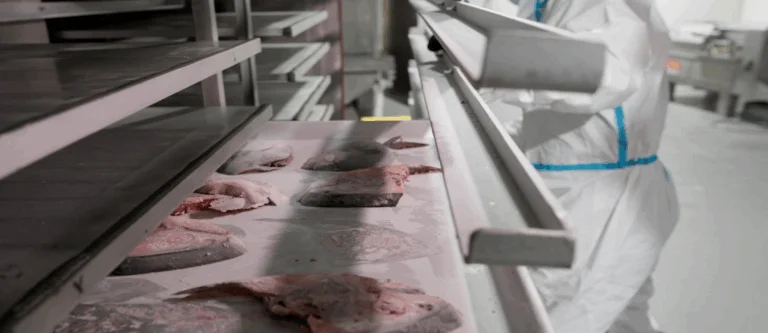
The frozen material is transferred to the chamber of a freeze dryer, and the chamber is evacuated with a vacuum pump. Typically, the chamber is pulled down to a high vacuum of around 40-60 Pa, after which gentle heat is applied to the material via heated shelves.
At this point, the ice begins to sublimate even below freezing, and the moisture leaves the product as vapor rather than liquid water. This vapor is then captured as ice on a condenser, also called a cold trap, inside the chamber. During primary drying, most of the ice crystals in the product, generally more than 90%, are removed.
Control of temperature and vacuum is critical. If the product temperature rises above the freezing point, partially dried areas may melt, causing the carefully formed porous structure to collapse. For this reason, heat is applied gradually, while internal product temperature sensors are monitored and shelf temperature is raised step by step.
For example, drying may begin under a vacuum of about 50 Pa, with sublimation drying continuing for 12 hours until the product core temperature reaches around 60°C. By avoiding excessive heating while ensuring complete ice removal, automated control systems can dry the product efficiently without scorching it. For many pet food ingredients, primary drying is completed in about 12 hours, and 98-99% of the initial moisture is removed.
- Secondary Drying (Desorption Drying)
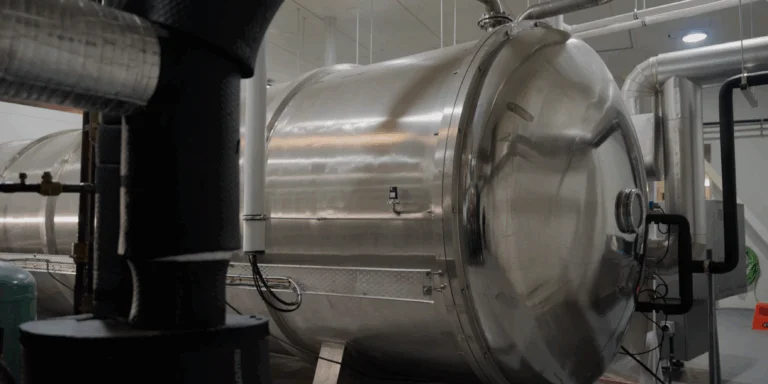
Once nearly all sublimable ice has been removed, a small amount of bound water still remains in the product. In secondary drying, the chamber is kept under high vacuum while the product temperature is raised further to around 70°C to drive off this residual moisture at the molecular level.
This stage typically takes 1-2 hours and reduces final moisture content to around 1-5%. For example, after 12 hours of primary drying, the product may remain under vacuum while the dryer temperature is raised close to 70°C for an additional 2 hours to dry the product core completely.
This secondary drying step results in a safe, shelf-stable dry food with low water activity (a_w).
- Packaging
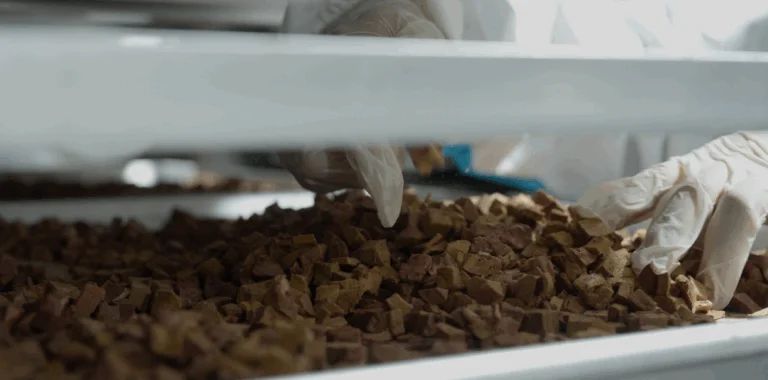
Once removed from the freeze dryer, the product quickly reabsorbs moisture from the air, so it should be sealed as quickly as possible.
After drying is complete, air is slowly reintroduced into the chamber to return it to atmospheric pressure, and the product is removed on trays. It is then promptly filled into packaging with high oxygen and moisture barrier properties, and sealed using oxygen absorbers and/or nitrogen flushing where appropriate.
Because freeze-dried foods are prone to lipid oxidation, blocking oxygen is essential. Minimizing moisture exposure is equally important for maintaining quality. In pet food, it is also common to place oxygen absorbers in the package after filling to help prevent oxidation.
In addition, each production lot should be tested for parameters such as moisture content and microbiological safety, and only lots that pass are released. This “test and hold” approach is an important control measure. With this, the freeze-dried product is complete and becomes a lightweight, long-shelf-life pet food.
Overseas Pet Food Imported into Japan
When importing pet food, including freeze-dried products, into Japan, it is also essential to understand that minimum heat-treatment conditions may be specified by animal species in order to manage livestock hygiene risks.
Below are representative examples of the minimum heat-treatment conditions required by the Animal Quarantine Service (MAFF/AQS) at the time of import into Japan. These conditions are defined in the Animal Health Requirements (AHRs) agreed with the exporting country and vary depending on the meat type, that is, the source animal.
Poultry-Derived Ingredients
Example:
the entire mass must be treated under one of the following conditions: 70°C for 30 minutes, 80°C for 9 minutes, or 90°C for 1 minute.
Pork-Derived Ingredients
Example:
the entire mass must be treated under one of the following conditions: 70°C for 30 minutes, 80°C for 9 minutes, or 90°C for 1 minute.
Ruminant-Derived Ingredients
Example:
Either:

a core temperature of at least 70°C for at least 1 minute using steam or boiling above 100°C

Or:

a core temperature of at least 70°C for at least 30 minutes using a hot water bath, hot-air drying, or similar treatment
Note: Dry pet food produced by extrusion and pet food in sealed containers such as retort pouches or cans may be excluded from the poultry and pork pet food protocol requirements.
What Matters Most in Freeze-Dried Manufacturing
To produce high-quality freeze-dried products, it is essential to manage process parameters carefully at every stage and incorporate smart formulation design. Below are some of the most important practical considerations from a development and production perspective.
Rapid Freezing and Ice Crystal Control
During freezing, ice crystal size strongly affects both drying efficiency and product quality. As noted above, rapid freezing creates small ice crystals, which reduce structural damage and help preserve nutrients and appearance. However, finer ice crystals take longer to sublimate, which lowers production efficiency.
Conversely, larger ice crystals sublimate more easily, but they also cause greater cellular damage and may reduce texture quality after rehydration. Developers must therefore determine the right balance between product quality and process efficiency and optimize freezing conditions according to the raw material and product shape. For example, if the material is formed into small pellets, the center can freeze quickly, making it easier to achieve both quality and efficiency.
Temperature and Vacuum Conditions During Sublimation Drying
In primary drying, the objective is to dry the product as quickly as possible without damaging it. In practice, shelf temperature is raised gradually while keeping product temperature below the freezing or eutectic point, and vacuum is maintained at a pressure low enough to promote sublimation.
If the vacuum level is insufficient, the ice may melt and drying will stall, so the performance of both the vacuum pump and condenser is important. Excessive heating can also cause case hardening, where the surface dries too quickly and traps ice inside. To avoid this, internal product temperature is monitored and vacuum conditions are adjusted stage by stage to achieve maximum sublimation speed within a safe operating range.
In recent years, technologies that monitor real-time weight loss and pressure changes during sublimation have also been used to detect the drying end point. These tools help optimize drying time, reduce energy loss from over-drying, and improve yield.
Rehydration Performance and Degree of Drying
For freeze-dried products, rehydration performance is a key quality parameter. If the porous structure left by sublimated ice is well preserved, water can penetrate quickly and restore softness close to the original state. To improve rehydration, it is important during pretreatment to keep raw materials as uniform as possible in size and thickness, thereby preventing uneven drying.
If under-dried areas remain, a hard core may remain during rehydration, or quality deterioration may begin from these areas during storage. For this reason, some manufacturers inspect the product after primary drying for any incompletely dried areas and apply additional drying when necessary.
Adjusting ice crystal size, for example by using slower freezing as noted earlier, can also enlarge pore size and further improve rehydration. However, this must be balanced against product texture and structural integrity, so decisions should be made according to the product concept.
Food Safety and Quality Assurance
Because freeze-dried products may be finished without heat treatment, careful control of microbiological risk is essential. Raw meat should be sourced from reliable suppliers with strong hygiene management, and the production environment must comply with GMP standards to prevent foreign material contamination and secondary contamination during manufacture. In some cases, HPP is applied during pretreatment, or a post-drying warm-air kill step is used.
Before shipment, it is also advisable to conduct third-party testing on each lot for pathogens such as Salmonella and Listeria, and to adopt a hold-and-release system in which only passing lots are released. From a quality assurance perspective, monitoring water activity and peroxide value (POV), an indicator of oxidative deterioration, is also useful.
In pet food, palatability trials with animals are another important quality metric. By confirming how small manufacturing adjustments affect final-product acceptance, developers can create products with more consistent quality and performance.
Comparison with Other Processing Methods, Including Air-Drying
Freeze-drying can be compared with other major pet food manufacturing methods such as kibble, air-drying, and wet food in cans or similar formats. Each method differs in strengths and weaknesses, nutrient retention, cost, and shelf stability. The table below summarizes the main points.
| Item | Freeze-Dried | Kibble (Dry) | Air-Dried | Wet (Canned) |
|---|---|---|---|---|
| Main advantages | Highest level of nutrient and flavor retention. Long shelf life without additives. High protein and low carbohydrate. | Highly efficient mass production and low cost. Easy nutrient fortification and stable supply. Convenient at room temperature. | Relatively good nutrient retention. Ultra-low-carbohydrate formulations are possible. Good balance of chewiness and palatability. | High moisture content makes it easy to eat. Very high palatability. Stable over long storage at room temperature. |
| Main disadvantages | Extremely high production cost. Non-heat-finished products require careful microbial risk control. Hygroscopic after opening and requires careful handling. | Some nutrient degradation due to high-temperature processing. High starch content leads to higher carbohydrates. Weaker natural ingredient flavor. | Production cost is relatively high. Moisture content requires mold control. Less suitable for large-scale production. | Heavy, with higher transport costs. Must be used quickly after opening. Sterilization can reduce nutrients and affect texture. |
| Nutrient retention | Excellent. Even heat-sensitive nutrients are largely preserved. Raw ingredient nutritional value is maintained. | Moderate. High-temperature extrusion requires vitamin fortification. Protein denaturation also occurs. | High. Low-temperature drying results in relatively little nutrient loss. Protein damage is limited. | Moderate. There is some loss from heat processing, but nutrients dissolved in moisture can also be consumed. |
| Cost | Highest. Often around JPY 20,000/kg, making it the most expensive format. | Lowest. Often from around JPY 2,000/kg due to mass-production efficiency. | Expensive. Typically lower than freeze-dried, but still around JPY 10,000/kg. | Moderate. Contents may be inexpensive, but water and packaging increase overall cost. |
| Shelf life | Excellent. Moisture below 5%; unopened shelf life of 24 months or longer is possible. No preservatives required. | Excellent. Unopened shelf life of around 18 months. Stabilized with antioxidants. | Good. Moisture typically around 10-15%. Unopened shelf life of 18-24 months is possible. | Excellent unopened shelf life of 2-3 years. After opening, however, it should be consumed within a few days. |
The above summarizes general tendencies, and actual performance varies by product. For example, the moisture content of air-dried foods differs by manufacturer; some New Zealand products are dried to around 14% moisture to improve shelf stability. Wet foods can also vary significantly: canned products generally store well for long periods, while chilled tray-packed products require refrigeration and often have shorter shelf lives.
Overall, freeze-dried products excel in nutrient and flavor retention but are costly; kibble is economical and convenient but involves some nutrient loss during processing; air-dried products occupy a middle ground; and wet foods are best understood as a format optimized for palatability.
Recipe Development and Formulation
Finally, the following section outlines formulation considerations for freeze-dried pet food. By designing ingredient composition and supplementation around the nutritional needs of dogs and cats, developers can optimize product quality and safety.
The above has provided a comprehensive overview of the key points in freeze-dried pet food development. Freeze-drying continues to attract attention in the premium pet food market because of its advantages in nutrient retention and high-protein formulation.
At the same time, it also presents challenges, including high production cost and strict safety management requirements. However, as explained in this guide, these challenges can be addressed through proper process control and thoughtful formulation design.
For product developers, the key is to leverage the benefits of freeze-drying to the fullest while staying informed about the latest technical trends and ingredient characteristics. High-quality freeze-dried food can be considered a next-generation product that contributes both to pet health and to owner satisfaction.