

 Shun Nagai
This guide is written for pet food developers. It summarizes up-to-date scientific findings on the feeding ecology of wild wolves and, importantly, explains how modern dogs differ genetically and physiologically from wolves. Using that foundation, it provides practical guidance for designing optimal dog food.
Below, we organize what wolves actually eat in the wild—including regional and seasonal variation—and the nutritional composition that can be inferred from those diets. We then compare this with nutritional requirements and palatability tendencies in modern dogs. Finally, we translate these insights into concrete product design actions (ingredient selection, nutrient balance, processing, palatability, and safety management).
Feeding Ecology of Wild Wolves
The wild gray wolf (Canis lupus) is primarily carnivorous and often hunts large mammals. At the same time, it is a flexible predator that can shift its diet depending on environmental conditions.
In North America, deer species (such as mule deer and elk) are major prey. In one survey, mule deer accounted for an average of 42% of the diet, elk 41%, and white-tailed deer 35%, indicating a high dietary contribution from cervids.
In Europe, medium-sized wild ungulates are central, with wild boar and roe deer each reported at 24%, and chamois (a mountain ungulate) at 21%. In parts of Asia, where wild prey may be scarce, domestic livestock (cattle, goats, poultry, etc.) can represent a substantial share of wolf diets.
Although regional differences are large, wolves generally prey on ungulates such as deer and wild boar, and opportunistically utilize a wide range of food sources—from small mammals like rabbits and rodents, to birds and fish. Hunting strategies also vary depending on prey size, ranging from cooperative pack hunting of large animals to solitary capture of smaller prey.
Seasonal dietary shifts are also well documented. In summer, wolves may increase their use of small prey and alternative food sources. For example, Himalayan wolves have been observed to consume more small mammals such as marmots in summer, while relying mainly on large wild ungulates in winter. This seasonal pattern is thought to reflect prey availability—marmots become difficult to catch in winter due to hibernation.
Notably, wolves may also consume plant-based foods (fruit) when abundant. A study in Minnesota (USA) reported cases in which wolves ate large quantities of blueberries during summer. In one pack, observations suggested that approximately 83% of the diet over a one-week period in July came from blueberries, and adults were even seen regurgitating berries to feed pups.
These examples highlight the wolf’s ecological flexibility. While the diet is fundamentally high-protein and high-fat, wolves can opportunistically include a broad range of foods—including fruit—depending on season, reproductive stage, and resource availability. This is important evidence for understanding what the dog’s ancestral lineage historically consumed.
Quantitative Nutrient Profile of Wolf Diets
When the prey consumed by wolves is analyzed as a whole—muscle, organs, bones, hide/fur, etc.—the inferred nutrient balance is strongly high-protein, high-fat, and extremely low in carbohydrates. Across multiple studies, the estimated macronutrient energy ratios for wolf diets typically fall within:
- Protein: ~30–54% of energy
- Fat: ~45–63% of energy
- Carbohydrate: ~1–7% of energy
One estimate reports an extreme profile of Protein 54% : Fat 45% : Carbohydrate 1%, while another scenario shows Protein 30% : Fat 63% : Carbohydrate 7%. Regardless of the specific context, a consistent conclusion emerges: digestible carbohydrates are minimal in wild wolf diets, and most energy comes from animal-derived protein and fat.
This profile aligns with the prey types described above (large mammals rich in muscle and fat). Interestingly, research also suggests that this general macronutrient pattern overlaps with the macronutrient balance preferred by modern dogs under certain self-selection conditions (discussed later), implying a physiological basis for these preferences.
Minerals and Micronutrients
Wolves appear to obtain essential minerals largely from whole-prey consumption. For example, estimated calcium and phosphorus intake from prey (including bones and organs) has been reported around Ca ~1.30 g per 100 g dry matter, with Ca:P ratios roughly ~0.83:1 to 1.3:1. A Ca:P ratio close to 1:1 is broadly similar to what is considered appropriate for canine growth and maintenance.
Some reports suggest that certain minerals, such as sodium and magnesium, may be somewhat lower in wild wolf diets compared with many commercial dog foods, potentially reflecting the composition of wild muscle tissue.
For vitamins, wolves likely obtain vitamin A and B vitamins through organs such as liver and other viscera, and possibly additional nutrients through gastrointestinal contents of prey. Essential fatty acids are also supplied naturally through animal tissues.
Overall, a whole-prey diet can be regarded as “complete and balanced” in the ecological sense: it contains a wide range of nutrients in ratios that can support survival and reproduction. This provides scientific support for “whole prey” (whole-animal) approaches that attempt to emulate ancestral feeding patterns in modern pet foods.
Practical Caveats
Even so, a wild-type prey diet is not automatically ideal in modern pet contexts. A very high-protein/high-fat pattern can lead to excessive caloric density for many sedentary household dogs. Some nutrients in wild prey (for example, vitamin D in organs) may reflect the prey animal’s own sunlight exposure and physiology—meaning that formulation adjustments may be necessary when translating the concept into manufactured products.
For dog food development, wolf dietary data should be treated as a valuable reference point—an anchor for thinking about what “species-appropriate” nutrient sources and patterns might look like—while still being adapted to modern lifestyle and safety needs.
Genetic Differences Between Wolves and Modern Dogs
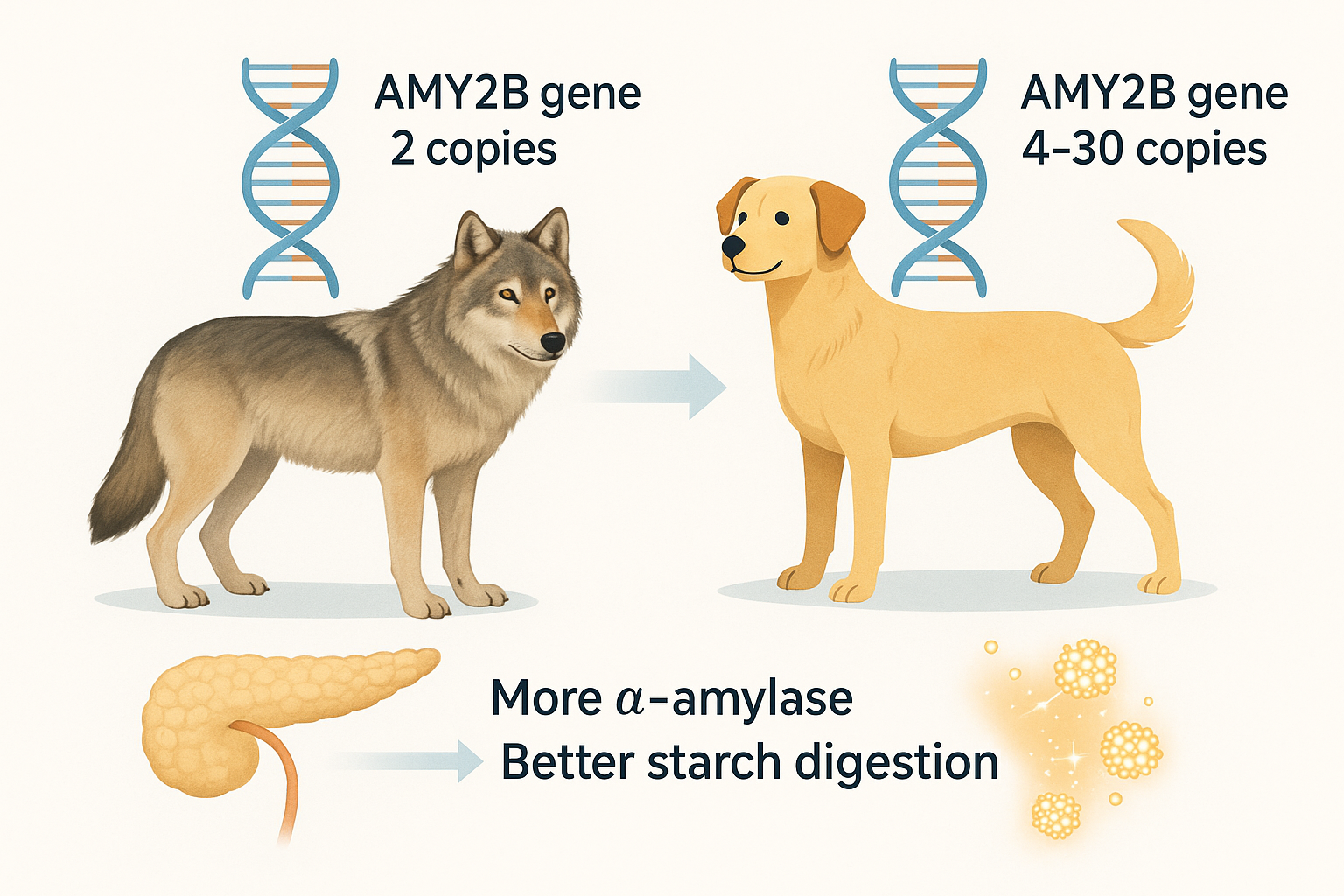
Genomic research has shown that domestication involved genetic adaptations, including changes related to diet. One major area of interest is starch digestion.
A landmark 2013 study reported that dogs, compared with wolves, show changes in multiple genes involved in starch and fat digestion and metabolism. In particular, dogs commonly have increased copy number of AMY2B, the pancreatic amylase gene. Wolves typically carry about two copies, whereas dogs may have roughly 4–30 copies depending on population and breed. On average, dogs have many more copies than wolves, which is thought to increase production of α-amylase, improving the ability to break starch into glucose.
One estimate suggests that for each additional AMY2B copy, serum amylase activity increases by about 5.4%. This adaptation is often linked to increased access to human food scraps containing starch, especially after the spread of agriculture. It may reflect a secondary adaptation associated with farming expansion rather than the earliest domestication stages.
Consistent with this idea, some indigenous dog populations from regions where agriculture spread later (for example, parts of the Arctic and some Oceanic regions) have been reported to show lower AMY2B copy numbers closer to wolves, suggesting local historical diets may have shaped genetic patterns.
Dogs also show strengthened capacity across the starch digestion and absorption pathway. For example, genes associated with maltose breakdown (such as MGAM) and glucose uptake in the small intestine (such as the transporter SGLT1) have been discussed as part of this broader adaptation.
In addition to carbohydrate digestion, differences have been reported in pathways related to lipid metabolism and vitamin A synthesis. Behavioral genetics (including genes influencing neural development) also appear to have shifted in ways associated with domestication traits such as reduced fear response, increased sociability, and improved stress tolerance.
Overall, dogs developed improved flexibility for utilizing more omnivorous, starch-containing diets. However, the fundamental gastrointestinal structure remains largely similar to that of wolves and is still well-suited to animal-based nutrients.
This is why it can be misleading to label dogs simply as “omnivores.” A more precise framing is that dogs are carnivore-leaning omnivores—animals that can digest and use carbohydrates, yet still retain strong biological capacity and preference for animal-derived protein and fat.
These genetic findings help pet food developers answer practical formulation questions such as: How much starch is reasonable? How should we balance high protein and fat? Dogs can utilize starch better than wolves, but they still preserve a physiology that can rely heavily on protein and fat as primary energy sources.
Comparing Wolf Diets with Modern Canine Nutrient Requirements
Modern nutritional guidelines define minimum or recommended levels for essential nutrients in dogs. Widely used references include NRC (National Research Council, 2006), FEDIAF guidelines (Europe), AAFCO nutrient profiles (USA), and WSAVA nutritional guidance.
Commercial “complete and balanced” dog foods are formulated to meet these standards.
Protein
Protein minimums for adult maintenance are commonly described as:
- AAFCO/FEDIAF: ≥18% crude protein on a dry matter basis
- NRC (adult): minimum ~20 g per 1,000 kcal (recommended ~25 g per 1,000 kcal)
Converted to an energy basis, this roughly implies that at least ~10% of total energy should be supplied by protein. In contrast, wild wolf diets are estimated at ~30–50%+ protein energy.
The minimum standards are therefore much lower than wolf dietary patterns. However, many higher-quality foods exceed the minimum substantially—often achieving ~30%+ crude protein (dry matter).
In healthy dogs, excess protein is generally metabolized as energy, but extremely high levels can create constraints in palatability, processing, and overall energy balance. In practice, many formulations target roughly 2–3× the minimum requirement, often around 30–40% crude protein (dry matter), depending on product goals.
Fat
For fat:
- AAFCO/FEDIAF: adult maintenance minimum around 5.5% crude fat (dry matter)
- NRC (adult): recommended ~13.8 g per 1,000 kcal (approximately ~13% of energy)
Commercial diets vary widely: weight-management formulas may be ~8–10% fat, while high-energy and puppy diets may exceed 20% (dry matter). Wolves, by contrast, often derive ~40–60% of energy from fat.
Dogs can digest fat efficiently (often >90%) and use it well as a primary energy source. However, in modern household settings, excessive fat can increase the risk of obesity. As a result, many pet foods adjust fat based on lifestyle: for active adult dogs, around ~15% fat (dry matter) may be common, while lower-activity dogs may be closer to ~8–12%.
In all cases, formulation must ensure essential fatty acids are met (e.g., linoleic acid minimums).
Carbohydrate
Notably, dogs do not have a defined physiological requirement for dietary carbohydrate. NRC explicitly states that required glucose can be supplied via gluconeogenesis; therefore, a minimum carbohydrate level is not established. FEDIAF and AAFCO similarly do not specify a carbohydrate minimum.
That does not mean carbohydrates are useless. Starch is an economical, digestible energy source and plays a key role in manufacturing—especially extrusion-based kibble, where starch gelatinization is important for structure, expansion, and texture. As a result, many dry dog foods contain ~40–50% carbohydrate, often driven more by processing and economics than by canine biological necessity.
Dogs can adapt to higher-starch diets, but from a palatability perspective, they generally show strong attraction to meat and fat flavors. Therefore, many formulas rely on animal-derived ingredients and palatability strategies to make starch-containing diets appealing.
Vitamins and Minerals
NRC and FEDIAF provide detailed requirements for minerals and vitamins. For example, adult maintenance targets often include:
- Calcium: minimum around 0.5% (dry matter)
- Phosphorus: minimum around 0.4% (dry matter)
- Upper limits are also considered, as excessive calcium can be risky.
Wolf prey diets yielding Ca:P ratios near ~1:1 align broadly with typical canine targets (often around 1:1 to 1.6:1 depending on guideline and life stage). Commercial foods commonly add calcium sources (bone meal, dicalcium phosphate, eggshell powder, etc.) and supplement trace minerals (including chelated forms) to achieve balance.
WSAVA emphasizes choosing foods labeled “complete and balanced” and appropriate for the dog’s life stage, because requirements change substantially for growth, reproduction, and lactation.
Wolf diets imply a high-protein/high-fat/low-carbohydrate pattern, while modern guidelines set much lower minimums for protein and fat and no requirement for carbohydrate. This gap suggests that dogs do not need an extreme wolf-like macronutrient profile, but they retain the ability—and often the preference—for diets strongly anchored in animal-derived nutrients.
Therefore, formulation requires balance: provide sufficiently robust animal nutrition (well above minimums when appropriate), avoid excessive calories in modern lifestyles, and minimize unnecessary components while meeting safety and regulatory standards.
What Dogs Prefer: Evidence from Self-Selection Trials
What macronutrient balance do dogs choose when given options? Self-selection feeding trials—where dogs are offered multiple foods with different macronutrient compositions—provide insight.
One representative result suggests that adult dogs tend to self-select approximately:
- Protein: ~30–38% of energy
- Fat: ~60% of energy
- Carbohydrate: only a few percent of energy
In one study across five breeds, dogs converged around ~34–38% protein energy, ~59–62% fat energy, and ~3–4% carbohydrate energy.
Strikingly, this resembles the estimated wolf macronutrient profile. Even though dogs evolved increased starch digestion capacity, they may still retain strong carnivore-like preferences and needs.
However, food choice is influenced by more than nutrient ratios. Aroma and flavor can strongly affect intake. High-fat and high-protein foods often have richer smells and tastes that dogs find attractive. Novelty effects may also exist: dogs can show increased interest when new ingredients appear, which could reflect ancestral flexibility across varying prey and seasons.
Some researchers suggest dogs may also exhibit nutrient-seeking behavior, selecting foods that help correct deficiencies in certain contexts. But household dogs rarely have the opportunity to self-select across diverse foods, so developers must translate these tendencies into balanced manufactured products.
In commercial development, palatability testing (e.g., two-bowl tests) is used to compare intake and preference and refine recipes. The core challenge is to reconcile what dogs want (palatability-driven intake) with what dogs need (complete and balanced nutrition).
Applying These Insights to Dog Food Development
Below are practical design principles for creating “optimal” dog foods for modern dogs, informed by wolf ecology but adapted for contemporary needs.
1. Ingredient Selection and Inclusion Strategy
Anchor the formula in high-quality animal protein. Following wolf feeding ecology, animal-derived proteins should be the primary foundation. Meats (chicken, beef, lamb, etc.) provide high-quality protein and fat, and typically enhance palatability.
Include organs strategically. Organs (liver, heart, etc.) supply micronutrients such as vitamin A, taurine, iron, and copper—functionally corresponding to the viscera portion of whole prey. However, liver is extremely high in vitamin A, so inclusion must be controlled (for example, keeping liver around ~5% of the formula, depending on total vitamin A contribution and regulatory limits).
Manage calcium and phosphorus deliberately. Wolves obtain calcium and phosphorus by consuming bones. In manufactured foods, calcium must be supplied via controlled sources (bone meal, dicalcium phosphate, eggshell powder, etc.) while maintaining an appropriate Ca:P ratio (often around ~1:1 as a working target, adjusted to guidelines and life stage).
Use carbohydrates for function, not ideology. Carbohydrate sources (wheat, corn, rice, potato, sweet potato, legumes, etc.) are not biologically required in dogs but are often valuable for extrusion structure, cost control, and digestible energy. Many high-meat formulas aim to keep carbohydrates lower (e.g., ~20–30% or less) while increasing animal ingredients, depending on the product concept.
Leverage fiber for gut support. Certain carbohydrate ingredients also provide dietary fiber, supporting fecal quality and gut function—important in practical product outcomes.
2. Processing Method and Nutrient Preservation
Dog foods include dry kibble, wet (cans/pouches), semi-moist, freeze-dried, and chilled/frozen raw formats. Processing determines allowable ingredients, shelf stability strategies, and nutrient retention.
Raw/chilled/frozen: Highest palatability and minimal heat damage, but requires rigorous pathogen control and cold-chain management. Technologies such as high-pressure processing (HPP), rapid freezing, and validated sanitation systems become essential.
Dry extruded kibble: High-temperature/high-pressure processing gelatinizes starch and enables crisp structure, but heat-sensitive vitamins can degrade. Solutions include post-extrusion vitamin application (coating) and/or overage design to account for processing loss. Excessive heat can also reduce protein digestibility in some cases, so formulation should include margin and ingredient quality controls.
Wet foods (retort sterilized): Retort processing also causes heat-related nutrient losses, but sealed packaging reduces oxidative deterioration and can improve aroma release and palatability. Texture stability and phase separation control become key quality targets.
Freeze-dried: Low-temperature dehydration better preserves flavor and certain nutrients, but costs are higher.
3. Palatability Optimization
No matter how “correct” a nutrition profile is, the product fails if dogs do not eat it. Key palatability practices include:
- Fat and digest coatings on kibble (oils, meat extracts, hydrolyzed proteins, meat powders) to intensify aroma and umami.
- Palatants (yeast extracts, fermented flavor systems, amino acid blends) to stimulate canine olfaction and taste.
- Controlled Maillard reaction to generate appetizing roasted notes without compromising safety or stability.
Smell is often considered the most influential driver of canine intake. Wet foods naturally release more aroma due to water content and are often highly palatable, but flavor stability over long shelf life can be a challenge. Some product strategies include topper recommendations, mixed texture concepts, or flavor rotation to reduce boredom.
4. Safety and Risk Management
Safety includes both nutritional safety and hygienic/microbial safety.
Nutritional safety requires avoiding both deficiencies and excesses. Calcium imbalance can cause skeletal issues; excessive vitamin A can contribute to bone abnormalities. AAFCO/FEDIAF guidelines include minima and, for some nutrients, upper limits. Developers must calculate total nutrient delivery from both ingredients and added premixes, including natural variability.
Microbial safety is critical whenever animal tissues are used. Raw meats and organs can carry pathogens such as Salmonella and E. coli. Heat processing in kibble and retorted wet foods largely controls these risks, while raw products require advanced control measures (HPP, validated freezing protocols, strict sanitation, supplier auditing, and robust testing plans).
Designing optimal dog food for modern dogs requires learning from wolves—but not blindly copying wolves. Wolves provide a biologically meaningful reference: whole-prey patterns are high in animal-derived protein and fat and very low in carbohydrate, and dogs still appear to retain strong preferences aligned with that profile. At the same time, modern dogs live in radically different conditions, and must be fed in ways that manage calorie density, meet current nutritional standards, preserve nutrients through processing, maximize palatability, and ensure rigorous safety.
Achieving that balance demands integrated expertise across biology, nutrition, food engineering, and veterinary science. We hope this guide helps pet food developers build evidence-based products that support healthier, happier dogs.