

 Shun Nagai
When importing pet food from overseas into Japan, one of the most important decisions for logistics managers is whether to ship by LCL (Less than Container Load) or FCL (Full Container Load).
Even if ocean freight arrangements and freight charges are borne by the seller, the importer in Japan is still directly affected by practical costs and operations on the Japanese side, including THC/CFS charges at the arrival port, customs clearance, domestic delivery, lead time, and quality risks.
LCL is effective for smaller shipment volumes, but it tends to involve a higher risk of damage or contamination due to cargo consolidation, as well as longer lead times. FCL, on the other hand, provides a dedicated container for one shipper, making it safer and faster, but it can become expensive when shipment volume is too small.
In this article, from the perspective of a Japanese importer, we explain in concrete terms the cost calculation models, break-even point, risk assessment, and decision-making process for choosing between LCL and FCL.
Basic Concepts of LCL and FCL
Less than Container Load
- A service in which cargo from multiple shippers is consolidated into a single container for transport.
- Suitable for small-lot cargo that does not fill an entire container.
Advantages
- Because charges are calculated based on cargo volume or weight, it is efficient for small shipments and avoids paying for unused container space.
- It allows goods to be shipped in smaller quantities as needed.
- There is less need to hold large amounts of inventory at once, which can help reduce warehousing and storage costs.
Disadvantages
- Because the cargo is transported together with other shippers’ goods, there is a greater risk of torn or dirty bags during loading and unloading, and there is also a possibility of cargo being mixed up with other shipments by mistake.
- Since deconsolidation and sorting work at the port are required, transit time tends to be longer.
- Additional charges such as CFS handling fees and documentation fees are more likely to accumulate.
Full Container Load
- A service in which one shipper exclusively uses an entire container.
- Because only one company’s cargo is loaded, safety and hygiene control are generally better.
Advantages
- Since the container is used only for your cargo, there is less concern about odor transfer, contamination, or dirt from other goods, making it more reliable from a hygiene standpoint.
- Unlike LCL, there is no need for deconsolidation and sorting at the port, so customs clearance and cargo release tend to proceed more smoothly and arrival is generally faster.
- The more cargo loaded into the container, the lower the shipping cost per cubic meter or per kilogram.
Disadvantages
- Even if the shipment volume is not enough to fill the container, the full container charge still applies, which can make it expensive.
- If the container remains too long at the port or warehouse after arrival, demurrage or detention charges may be incurred once the free time expires.
Typical Container Sizes and Capacities
| Type | Internal Dimensions (approx.) | Volume Capacity | Payload Capacity |
|---|---|---|---|
| 20ft GP | 5.9 × 2.3 × 2.4 m | approx. 28–30 m³ | up to approx. 24 t |
| 40ft GP | 12.0 × 2.3 × 2.4 m | approx. 60–62 m³ | up to approx. 26 t |
| 40ft HC | 12.0 × 2.3 × 2.7 m | approx. 67–75 m³ | up to approx. 26 t |
3 Key Points for Making the Right Decision
When comparing LCL and FCL, there are three key factors to consider first:
- Cargo volume: the total shipment volume (CBM, cubic meters)
- Cargo weight: the total actual weight (kg)
- Damage rate / risk: the likelihood of cargo damage or contamination
For pet food, the most important practical indicators are shipment volume and weight, such as how many pallets of bagged dog food are being shipped. These should be evaluated together with product value and the risk of damage when consolidated with other cargo, such as torn bags, odor transfer, or contamination.
CBM, Weight, and RT Required for LCL
When calculating logistics costs, the billable quantity is determined based on CBM (Cubic Meter) and weight (kg). In LCL shipping, this is expressed as RT (Revenue Ton), which means the greater of 1 m³ or 1,000 kg.
In other words, for LCL ocean freight, the chargeable unit is based on whichever is greater: cargo volume or cargo weight. This is known as the Weight or Measure principle.
For example, if dog food is shipped in a volume of 2.5 m³ and a weight of 1,500 kg, then the weight is equivalent to 1.5 tons, so the larger number is 2.5, meaning the chargeable RT is 2.5 RT.
By contrast, for very heavy cargo such as metal products, the weight tonnage may become the RT instead.
In addition, LCL usually has a minimum chargeable quantity, such as 1.0 RT. Even if the actual cargo is smaller, at least 1 m³ equivalent may still be charged. This means extremely small shipments can become disproportionately expensive even under LCL.
FCL, on the other hand, is based on a fixed charge per container, subject to the container’s volume limit and weight limit. For example, a 20ft container has a capacity of about 28–30 m³, while a 40ft container has around 60 m³, and the maximum payload is generally about 25 tons for either size.
LCL: mainly variable charges based on cargo volume/weight, meaning “the more you ship, the more you pay.”
FCL: mainly fixed charges per container, meaning “a set price per container.”
Cost Structure Comparison: LCL vs FCL
| Cost Item | LCL | FCL |
|---|---|---|
| Charging Unit | RT (volume/weight) | Per container |
| Minimum Charge | Yes (e.g. from 1 m³) | No (starts from one full container) |
| Rounding Rule | Rounded up (e.g. by 0.1 m³) | None |
| Economy of Scale | Advantageous for small shipments | Advantageous for large shipments |
| Main Price Drivers | Cargo volume, market conditions | Container size, market conditions |
LCL Cost Breakdown and Pricing Logic
The core LCL freight rate is generally quoted as a W/M rate, such as XX THB/RT, and ocean freight increases in proportion to RT.
LCL shipments also incur CFS charges for stuffing and de-stuffing consolidated cargo, and these are usually charged per RT. In addition, THC is charged according to RT in many cases.
There may also be separate fixed charges such as documentation fees and, depending on the case, consolidation handling fees.
LCL Cost Formula
Can also be used as an Excel formula:

=MAX(RT_min, CEILING(MAX(Volume m³, Weight kg/1000), Step)) * Rate + Fixed_LCL

Definitions
RT_min: the minimum chargeable RT for small shipments (if not specified, 1.0 m³ may be used as a reference)
Step: the rounding increment (if not specified, 0.1 m³ may be used as a reference)
Rate: W/M rate (example: USD 100/m³)
Fixed_LCL: fixed LCL charges such as documentation fees
Hidden Costs to Watch
- Minimum charges making very small shipments expensive
- Rounding up leading to an effective 10–20% cost increase
- Delays and storage charges caused by CFS handling time
FCL Cost Breakdown and Pricing Logic
In FCL shipping, costs are mainly fixed on a per-container basis. The main components are ocean freight, THC charged per container, and inland drayage costs such as trucking from the factory to the origin port or from the Japanese port to the warehouse.
For example, THC at a Japanese port may be quoted as a fixed amount per container, such as JPY 40,000 for a 20ft container.
There may also be documentation fees, B/L issuance fees, fuel surcharges, and cargo insurance. Unlike LCL, FCL costs do not depend on cargo quantity within the container, so the more cargo you load, the lower the unit cost becomes.
FCL Cost Formula

CFCL = Ocean Freight + THC (FCL) + Inland + Docs + Other

This is basically a fixed-cost structure determined by the number and size of containers, regardless of the exact cargo volume loaded.
- In LCL quotations, always confirm the RT rounding rule.
- In FCL, compare annual contract rates and spot rates.
- Do not judge based only on ocean freight; compare the total end-to-end cost.
How to Find the Break-Even Point
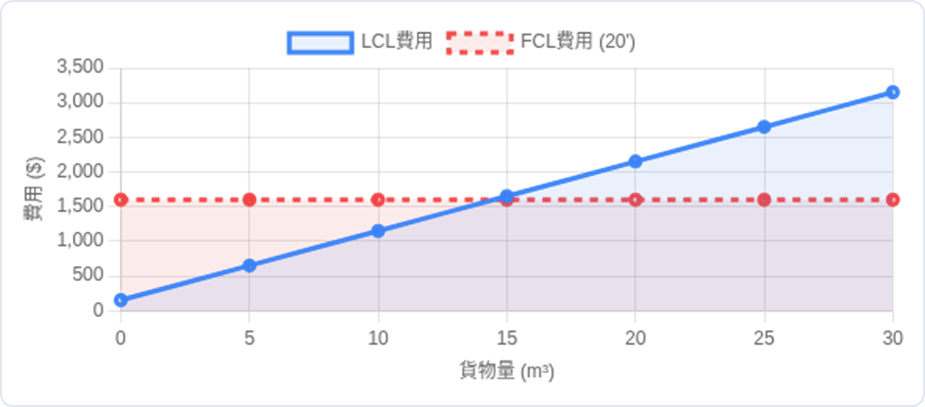
Once the LCL cost and FCL cost are calculated using the above formulas, the break-even shipment volume can be determined by solving for the RT at which:
LCL total cost = FCL total cost
Simple Example
Assumptions
LCL rate = $100/m³
Minimum charge = 1 m³
Rounding increment = 0.1 m³
Fixed LCL fee = $150

20ft FCL cost
Ocean freight = $1,200
THC = $300
Drayage = $100

Total FCL cost = $1,600

If shipment volume is 10 m³
LCL cost = 10 × $100 + $150 = $1,150
FCL cost = $1,600

Break-even point
Approximately 15 m³
(15 × $100 + $150 = $1,650, which exceeds $1,600)
In reality, however, the exact RT break-even point depends on forwarder quotations and destination-side charges, so it cannot be fixed universally. Still, knowing an approximate threshold makes practical decision-making much easier.
Practical Break-Even Guidelines
For a 20ft container
Once the shipment exceeds about 13 m³, FCL tends to become more economical.
For a 40ft container
The comparison should be made against using one 40ft container versus multiple 20ft containers.
In general, for a 20ft GP container, 12–15 m³ is a useful benchmark. Cargo above around 13 m³ often shifts the advantage toward FCL, while cargo below that level is more likely to be cheaper under LCL’s variable-rate structure.
For a 40ft HC container, with a capacity of approximately 67–75 m³, the shipment volume must be significantly larger before FCL becomes advantageous. The break-even point is often around 25–30 m³.
Of course, actual results vary by weight and route, but once the shipment exceeds the equivalent of one 20ft container’s practical volume, FCL is usually the natural choice.
The Damage Risk You Must Not Ignore
| Risk Type | LCL Risk Level | FCL Risk Level |
|---|---|---|
| Contamination from liquid leakage | High | Low |
| Odor transfer / foreign smell | High | Low |
| Pest or microbial contamination | Medium | Low |
| Packaging damage / content leakage | High | Low |
| Transit delay / loss | Medium | Low |
In addition to cost, one of the most important factors is the risk of damage or contamination. For products such as pet food, which are food-related goods, contamination from odor transfer or liquid leakage is a serious issue that should be avoided.
Because LCL shares a container with other companies’ cargo, there are cases where leakage or damage from another shipment affects your goods. For example, a liquid product loaded in the same container may spill and wet dog food bags, or chemical odors from nearby cargo may transfer and reduce product value.
In addition, LCL involves more cargo handling and sorting steps, increasing the risk of label loss, misdelivery, loss, or torn bags.
If the probability of damage is high, or if the financial impact of a single incident would be significant, then FCL should be selected from the outset even when shipment volume is somewhat small. Paying more for a dedicated container can help isolate the risk and prevent serious damage.
This is especially important for pet food, because odor contamination or foreign matter contamination can affect not only the product itself but also the company’s brand reputation. For this reason, it is advisable to establish an internal rule such as “Choose FCL immediately whenever risk avoidance is the priority.”
Points to Watch When Estimating Costs
When comparing LCL and FCL, there are several easily overlooked points and common mistakes in practical cost estimation.
Double Counting THC
Depending on the Incoterms and contract terms, local charges such as THC may arise both at origin and at destination. Under DDU, port costs on the Japanese side may be borne by the seller, whereas under CIF, destination THC is generally borne by the buyer. For both LCL and FCL, port charges arise on both the export and import sides, so careful checking is essential.
Overlooking Rounding Rules and Minimum Charges
For LCL quotations, always confirm the RT rounding increment and minimum charges. For example, a cargo volume of 0.4 m³ may still be charged as 1.0 m³, or 10.1 m³ may be rounded up depending on the forwarder’s rule. If these are ignored, the actual charge may be underestimated.
Failing to Consider Peak Season and Surcharges
Ocean freight rates fluctuate throughout the year. During peak seasons, such as before year-end sales campaigns or Lunar New Year, additional charges such as PSS (Peak Season Surcharge) may apply, and some months may see a GRI (General Rate Increase).
Fuel adjustment charges such as BAF may also change depending on fuel prices, creating differences between the quotation date and the actual shipping date. Port congestion surcharges and container shortage surcharges may also arise depending on market conditions. If shipments are spread across multiple dates, future rate trends should also be taken into account.
Missing Special Cargo Charges
Dangerous goods and reefer cargo involve extra charges, but there are also other potential costs such as temperature logger rental fees, VGM (Verified Gross Mass) fees, and customs inspection costs.
These can arise under both LCL and FCL, but in LCL they may sometimes be billed through the forwarder and not clearly shown on the initial quotation. It is therefore important to confirm in advance: “Are there any additional charges not included here?”
Demurrage / Detention Caused by Insufficient Free Time
In FCL shipping, if the container is not returned within the free time, demurrage or detention charges will apply. For example, if the free time is 5 days but customs clearance is delayed and warehouse delivery is not completed in time, penalties can accrue on a daily basis.
LCL can also incur CFS storage charges, but FCL demurrage tends to be higher and can accumulate quickly. When comparing total costs, it is wise to incorporate delay-related risks, especially at ports where congestion or customs delays are common.
Checklist and Decision Flow
| Item | CIF | DDU |
|---|---|---|
| Export customs clearance | Seller bears cost | Seller bears cost |
| Origin THC | Seller bears cost | Seller bears cost |
| Ocean freight | Seller bears cost | Seller bears cost |
| Insurance | Seller bears cost | Seller bears cost |
| Destination THC | Buyer bears cost | Seller bears cost |
| Import customs clearance | Buyer bears cost | Seller bears cost |
| Duties and taxes | Buyer bears cost | Seller bears cost |
| Inland transportation | Buyer bears cost | Seller bears cost |
Finally, below is a checklist and decision flow for selecting between LCL and FCL. This summary is designed to make practical decision-making easier.
Quick Decision Guide (Based on 20ft Container)
| Shipment Size | Volume | Recommendation |
|---|---|---|
| Small shipment | 1–10 m³ | LCL recommended |
| Middle range | 10–15 m³ | Detailed cost calculation required |
| Large shipment | 15 m³ and above | FCL recommended |
It is recommended that this checklist be reviewed jointly by both the quality management manager and the logistics manager.